Many children in a cantonment town grow up watching men and women in uniform. Some decide very early that they want to wear one. Parents then face a practical question long before the National Defence Academy is on the horizon: what kind of schooling gives a ten- or eleven-year-old the best start, without sacrificing regular studies or childhood along the way?
The answer for many families is a defence school: a school that combines regular academics with entrance preparation for Sainik Schools, the military schools, RIMC and Navodaya, and builds the physical fitness and personal qualities that the services look for later. This guide explains what such a school does, how it differs from coaching, what a day looks like, and what to check before choosing a defence school near Ambala.
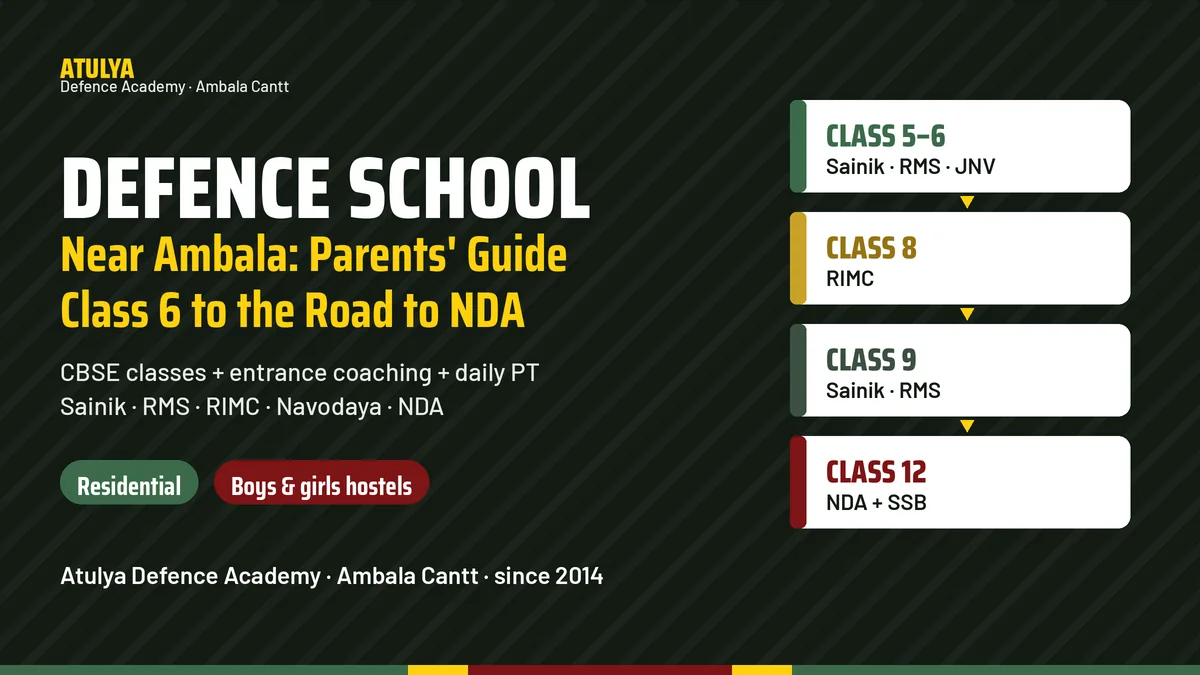
In brief: a defence school runs regular CBSE classes and entrance coaching under one timetable, adds daily physical training and a disciplined routine, and usually offers hostel facilities. Class 5 and Class 6 are the natural starting points, because the main entrance tests for Class 6 (Sainik School, military school, Navodaya) happen in that year.
What is the difference between a defence school and normal coaching?
| Point | Coaching centre | Defence school |
|---|---|---|
| School studies | Child attends a separate school | CBSE classes on the same campus |
| Hours | A few hours after school | Full day, planned around both goals |
| Physical training | Rarely | Daily PT, drill and sports |
| Routine and discipline | Depends on home | Fixed timetable, often residential |
| Personality and SSB groundwork | Not covered | Public speaking, leadership tasks, group activities |
| Exams covered | Usually one or two | Sainik School, military school, RIMC, Navodaya, later NDA |
Coaching suits a child who already attends a good school and needs focused test practice for a few months. A defence school suits a family that wants the whole day organised around both school and the defence goal, especially when the child is aiming at a residential Sainik School or military school, where the routine will be similar.
What does a typical day look like in a defence school?
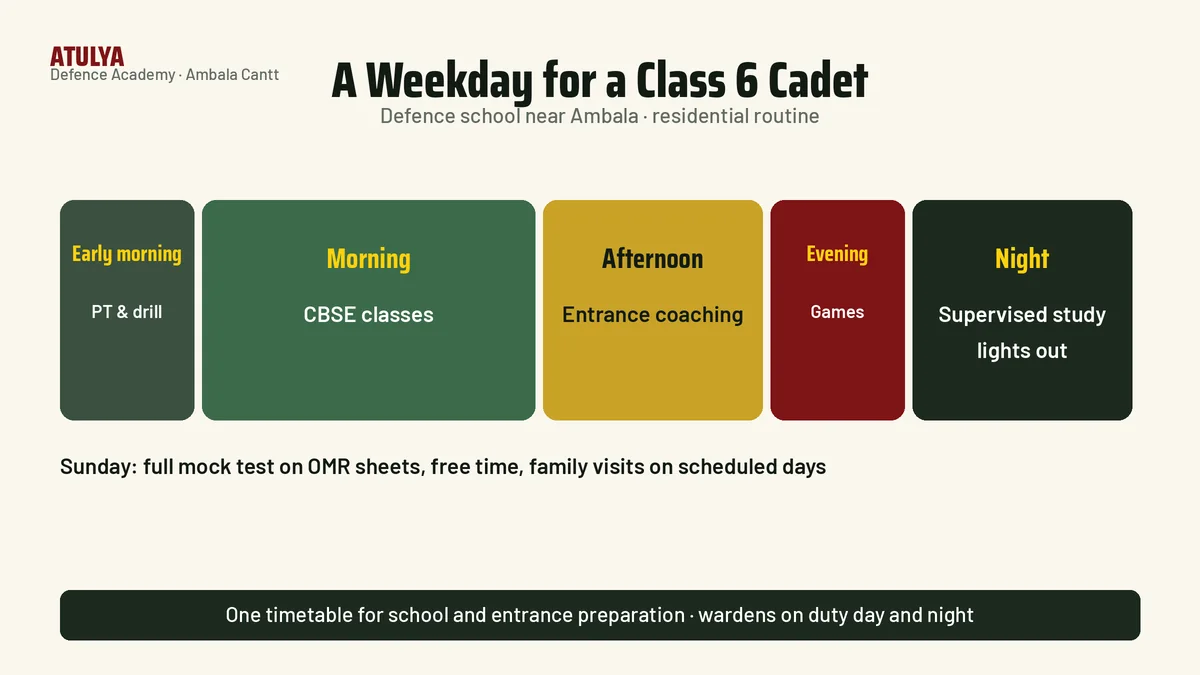
Every campus runs its own timetable, but the shape is similar. At ours, a weekday for a Class 6 cadet looks like this:
| Time | Activity |
|---|---|
| Early morning | Wake-up, physical training, drill |
| Morning | Breakfast, assembly, CBSE classes |
| Afternoon | Lunch, rest, then entrance coaching (maths daily, reasoning, English, GK) |
| Evening | Games and sports on the ground |
| Night | Supervised self-study, dinner, lights out |
On Sundays, entrance students write a full mock test on OMR sheets, followed by free time and, on scheduled days, family visits. The hostel follows written rules on phones, outings and leave, which parents receive at admission. Our hostel handbook sets these out.
Which exams can a child prepare for from Class 6?
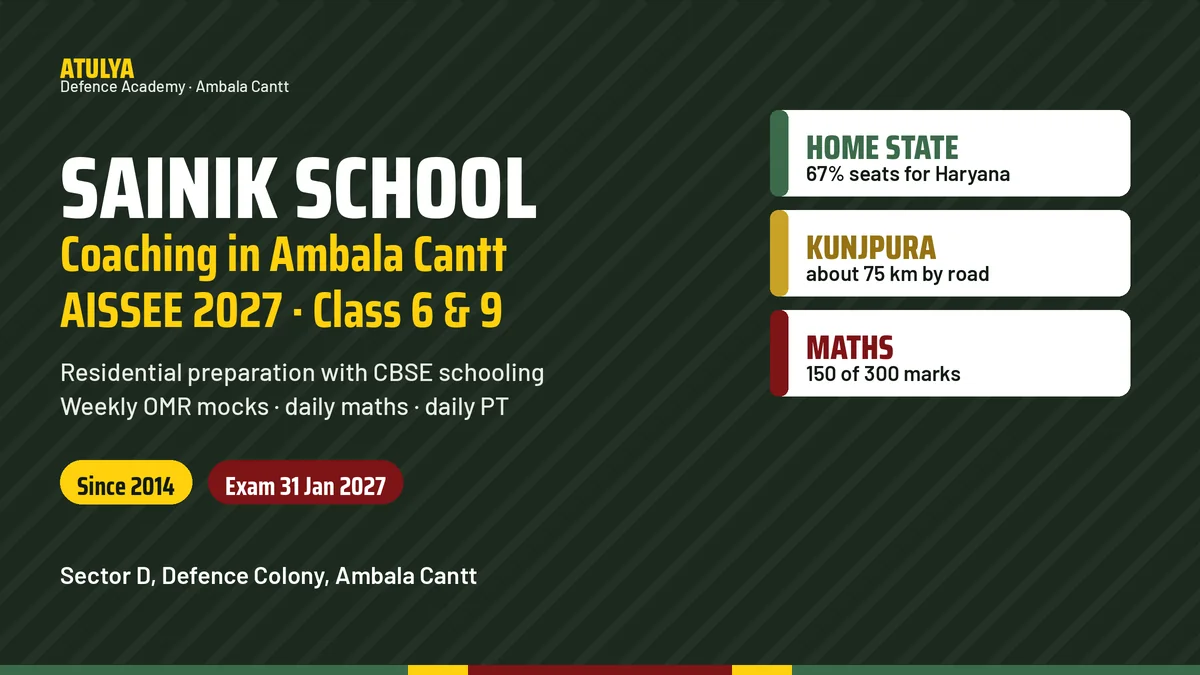
- From Class 5, for Class 6 entry: the Sainik School entrance (AISSEE), the military school test (RMS CET) and the Navodaya test (JNVST).
- From Class 6–7, for Class 8 entry: RIMC Dehradun, which admits at Class 8 through its own entrance and interview.
- From Class 7–8, for Class 9 entry: Sainik School and military school Class 9 papers.
- From Class 11–12: NDA, with the SSB interview after the written exam.
A child who starts in Class 5 or 6 has several chances over the following years, and each preparation builds on the last. That long runway is the main reason families consider a defence academy near Ambala at this age rather than waiting until Class 11.
Can a child do CBSE studies and RIMC/Sainik prep together?
Yes, and in a well-run defence school the two support each other. The entrance tests at Class 6 and Class 8 draw on the same maths, English and general science that the CBSE syllabus covers, at a slightly higher speed. The extra effort goes into timed practice and topics the school syllabus covers lightly, such as reasoning and current affairs. What does not work is piling evening coaching on top of a full school day elsewhere; tired children stop learning.
The calendar also needs planning. The three Class 6 entrance tests fall between late November and late January, close to school half-yearly and pre-final exams. A school that runs both under one roof can schedule its own tests around the entrance dates, so a child is not preparing for two exams in the same week.
Do defence schools teach SSB and personality skills?
A good one starts early, though not with formal SSB coaching for eleven-year-olds. At this age the groundwork is simple: speaking in front of a group, taking responsibility for a small team task, writing a short story from a picture, keeping one's kit in order, and playing team games fairly. These habits grow into the officer-like qualities the Services Selection Board looks for when the cadet appears for NDA years later. Our personality development page describes how we build them by class.
Who teaches?
Subject teachers handle the CBSE classes and entrance coaching. Physical training is led by trained instructors. Our mentors include retired defence personnel, who bring the experience of service life and the interview process to talks, drill and individual guidance.
Is there a good defence school near Ambala?
There are a few options in and around the district, and the right defence school near Ambala for one family may not suit another. We would rather you compare carefully than choose us by default. Check these when you visit any school:
- CBSE classes running on time, with qualified teachers, not just coaching staff.
- A written weekly mock-test schedule and records of how mistakes are reviewed.
- Daily PT on a proper ground, not a corner of a building.
- Clean dormitories, washrooms and kitchen; a medical room with a nurse or doctor on call; a warden on duty at night.
- Separate, supervised accommodation for girls if you have a daughter.
- A clear fee structure in writing, with what is and is not included.
Is a defence school only for boys or for girls too?
Girls are welcome. Sainik Schools have admitted girls to Class 6 since 2021-22, and the military schools also admit girls at Class 6. NDA has accepted women cadets since 2022. At Atulya, girls live in a separate hostel with their own wardens and follow the same academic and training routine.
Defence school mein admission Ambala se kaise lein?
Pehle campus dekhne aayein, class aur hostel dono dekhein. Phir admission form, bachche ki pichhli class ka report card, birth certificate aur photo ke saath admission process poora karein. Entrance ki taiyari ke liye Class 5 sabse sahi samay hai.
How far is Ambala from Ambala for a residential defence school?
Families sometimes mean Ambala City and Ambala Cantt, which are twin towns about 8 km apart. Our campus is in Sector D, Defence Colony, in the cantonment, reachable by auto or cab from either town's railway station. For a residential school this distance matters for visiting days and emergencies: parents from the city can reach the campus in about twenty minutes.
Signs a child is ready for a residential routine
Not every ten-year-old is ready to live away from home, and forcing it can backfire. From what we see at admission, children who settle well usually show a few of these signs: they can manage basic self-care (bathing, packing a bag, keeping track of their things), they sleep away from home without distress, they enjoy sports or group activities, and they themselves talk about the army or a uniform career. A child who has never spent a night away might start as a day scholar for a term and move into the hostel later. There is no shame in a gradual start; it often works better.
The first month: settling in
Almost every new cadet misses home in the first two or three weeks. It usually shows up as quietness at night, phone calls that end in tears, or a sudden stomach ache before school. Wardens and teachers expect this. What helps: a fixed time for phone calls rather than many short ones, letters or small notes from home, and parents who sound cheerful on the phone even when they miss the child. By the fourth week, most children have friends, a place in a sports team and a routine they are proud of. If a child is still unhappy after six weeks, talk to the warden and the class teacher together; there is usually a specific cause that can be fixed.
A year plan from Class 5 to Class 6
| When | What happens |
|---|---|
| April–June | Join; build maths and reading base; start PT |
| July–September | Full syllabus for the three entrance tests; Navodaya form |
| September–October | Military school and Sainik School forms; weekly mocks begin |
| November–January | Navodaya (late Nov), military school (mid Dec), Sainik School (late Jan) |
| February–May | Results, interviews, counselling, medicals |
Looking for a military school near Ambala?
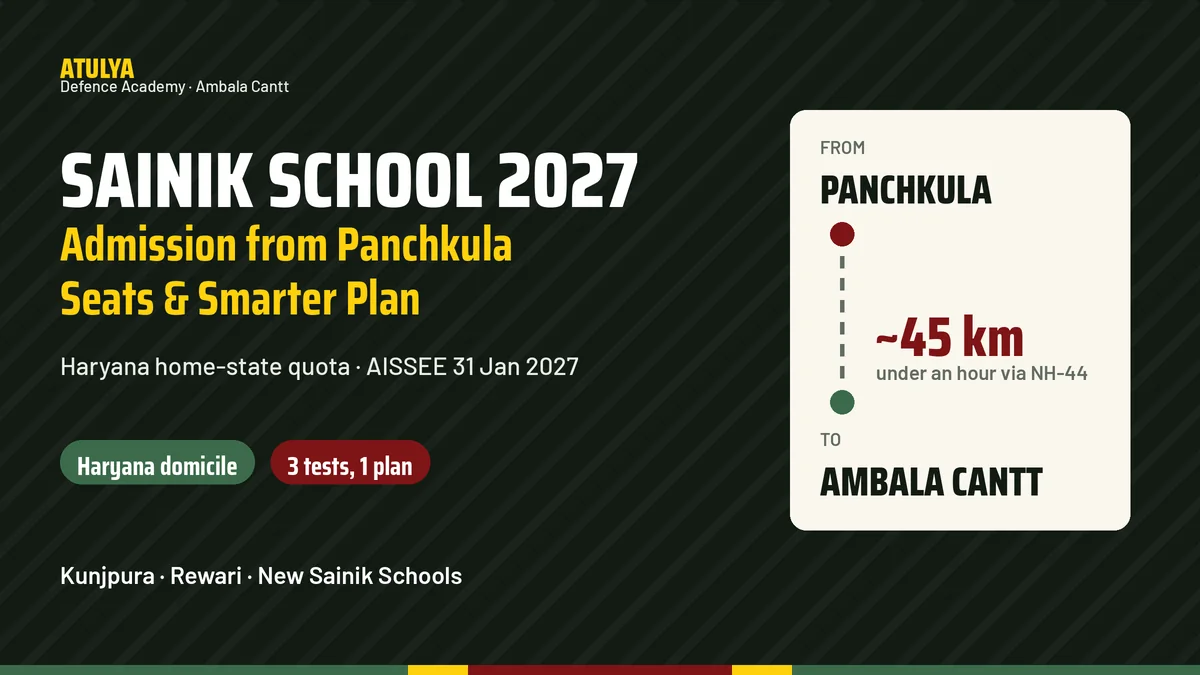
Parents often use "military school" for any defence-oriented school. Strictly, the five Rashtriya Military Schools are run by the Army, and the nearest one to families searching for a military school near Ambala is at Chail in Himachal Pradesh, about four hours away. Admission is through a written test in December. A local defence school is where many children prepare for that test, and for the Sainik School and Navodaya tests in the same season.
What are the fees of a residential defence school?
Fees vary a lot between schools, depending on hostel facilities, food, class size and what is included (uniform, books, coaching material, tests). Ask every school for a written fee schedule that lists tuition, hostel, mess, coaching and one-time charges separately, and compare like with like. For our current fee structure, call the admissions desk; it is shared with each family along with the payment options described on our fee payment page.
Defence coaching for Class 6 in Ambala: where to start
If your child is in Class 4 or 5 now, begin with a visit and a short assessment of their maths and reading. That tells you whether they are ready for an entrance attempt this season or would benefit from a year of groundwork first. Either way, the earlier the habits of daily practice and physical fitness begin, the easier the road to a school with NDA coaching near Ambala, and later to NDA itself. Our programme overview shows how each class fits into the path.
See the campus for yourself
Visit on a weekday to watch PT, a class and evening study, or on a Sunday to see a mock test. Call 98121-97229 to fix a time.
Sources
- Sainik Schools Society, Ministry of Defence: sainikschool.ncog.gov.in
- Rashtriya Military Schools: rashtriyamilitaryschools.edu.in
- Rashtriya Indian Military College, Dehradun: rimc.gov.in
- Union Public Service Commission, NDA examination: upsc.gov.in
Information checked on 22 October 2026.