By late October the form is submitted, the fee is paid, and the written test for the five Rashtriya Military Schools is about seven weeks away. This is the stretch where preparation either comes together or falls apart. Children who have studied all year often stall now because they keep reading instead of testing themselves. Children who started late panic and try to cover everything. Neither approach uses the remaining weeks well.
This RMS CET preparation strategy is built around one idea: the final two months are for converting knowledge into marks under exam conditions. That means full mock tests, a disciplined review of mistakes, and steady work on the weakest subject, because in this test a low score in one subject can cancel a high score in another.
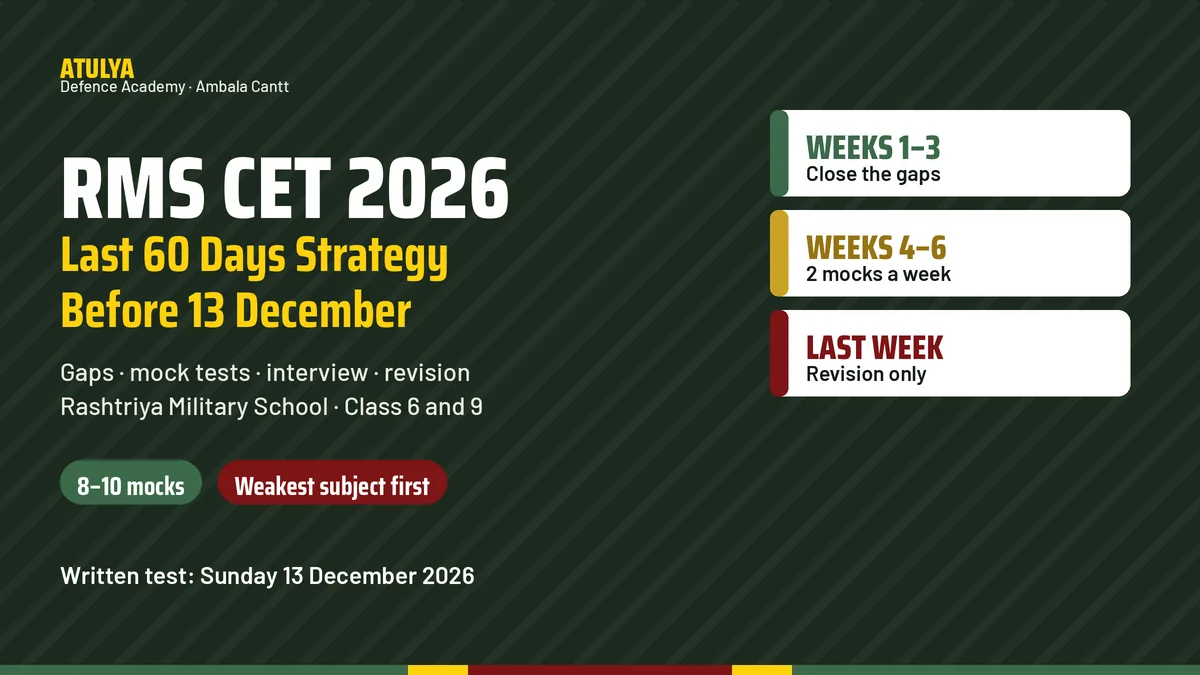
The plan in brief: weeks 1–3 for closing gaps in the weakest subject plus one mock a week; weeks 4–6 for two mocks a week and interview practice; the final week for revision only. Throughout: a daily English reading habit, short timed sets in every subject, and a mistake notebook.
First, know what you are preparing for
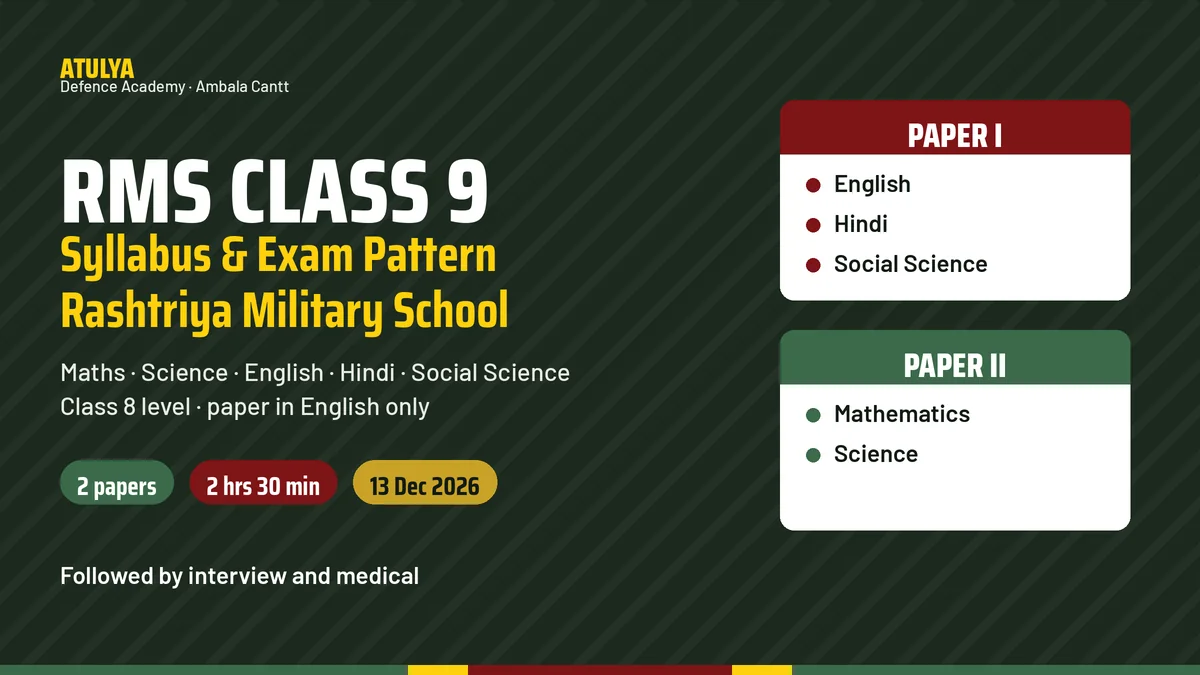
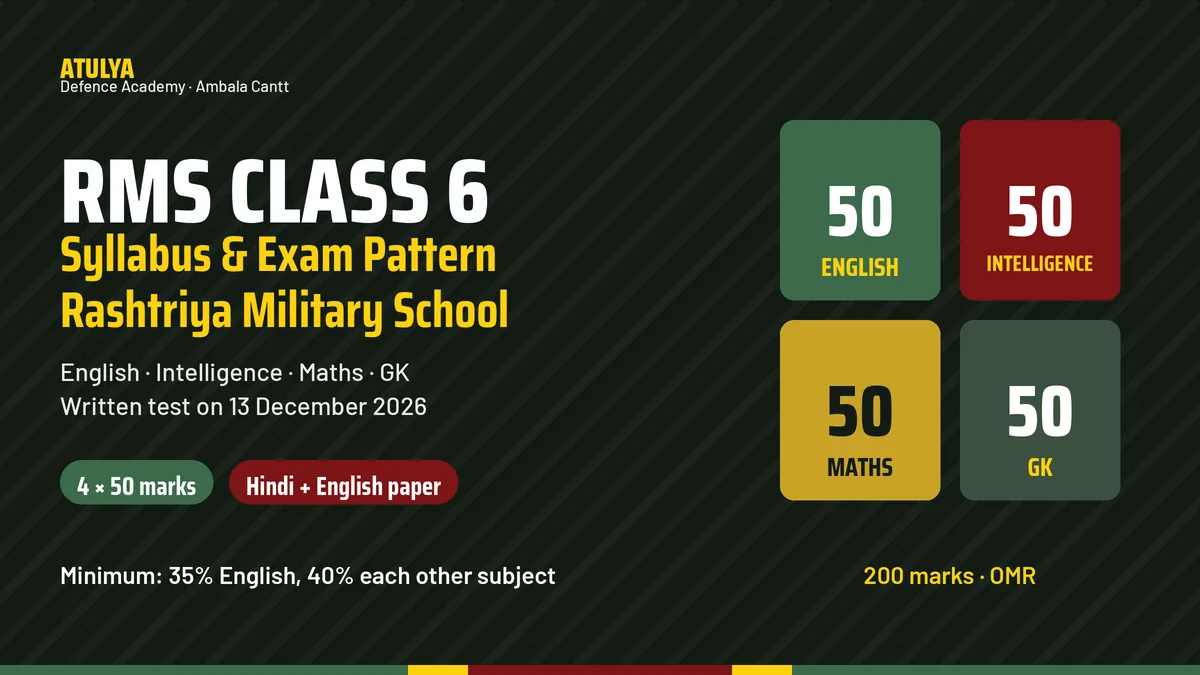
For Class 6, the paper has four subjects with 50 one-mark questions each: English, Intelligence, Mathematics, and General Knowledge with Current Affairs. A child must score at least 35 percent in English and 40 percent in each of the other three to qualify. For Class 9, the paper is in English only, covers English, Hindi, Social Science, Mathematics and Science across two papers, and lasts two and a half hours. Detailed topic lists are in our Class 6 syllabus and Class 9 syllabus guides.
The qualifying rule shapes the whole plan. Look at the lowest subject score in every mock, not the total. That subject gets extra time until it is safely above its minimum.
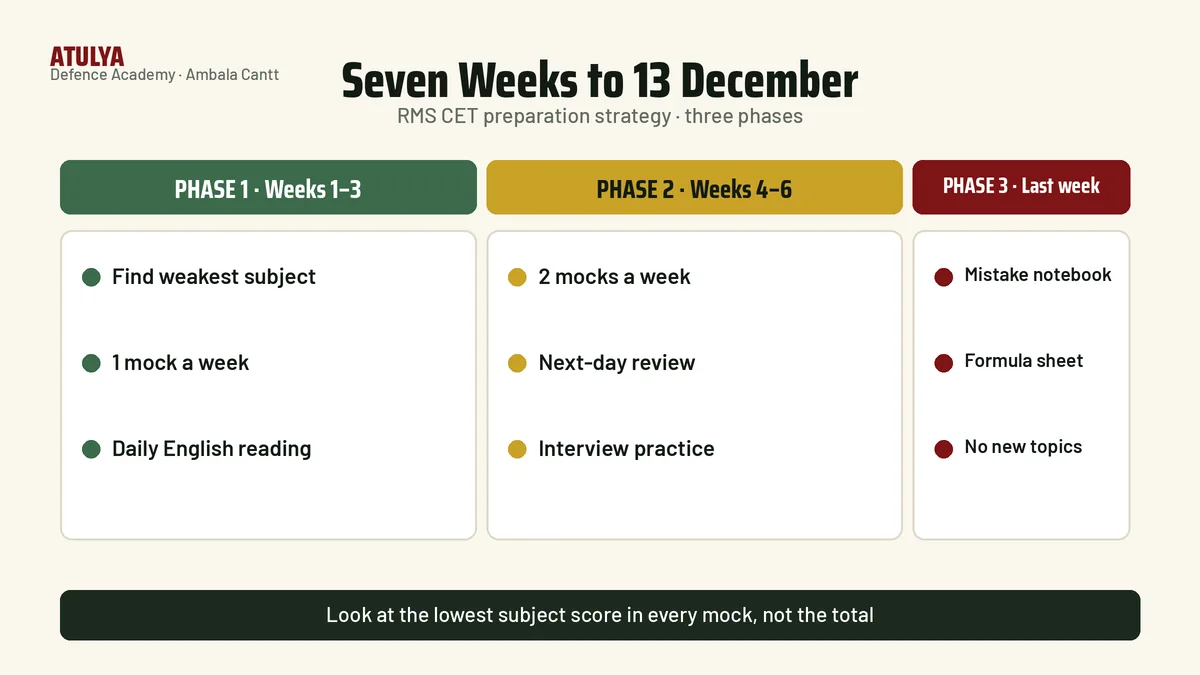
Phase 1 (weeks 1–3): close the gaps
Start with one full mock on a Sunday morning, under the real time limit, on a printed OMR sheet. Mark it the same day and list the subject scores. The weakest subject becomes the focus for the next three weeks.
A daily routine for a Class 5 child in this phase, about two hours on school days:
| Block | Minutes | What to do |
|---|---|---|
| Weakest subject | 40 | One topic: learn, then 20 timed questions |
| English reading | 20 | One passage aloud, five questions, five new words |
| Maths | 25 | 15 mixed questions against the clock |
| Intelligence | 20 | 25 questions of two types |
| GK and news | 15 | One static topic plus the day's headlines |
Class 8 students preparing for Class 9 can use the same structure with science and social science in place of GK and intelligence, and slightly longer blocks.
Phase 2 (weeks 4–6): test, review, repeat
How many mock tests before RMS CET?
We aim for eight to ten full mock tests in total before 13 December: one a week in the first phase, then two a week in the second. More than that leaves no time to study the mistakes, which is where the improvement actually happens. Each RMS CET mock test should be followed the next day by a review session of at least 45 minutes.
In the review, sort every mistake into one of four groups: did not know the topic, misread the question, ran out of time, or careless slip. Each group has a different fix. Topic gaps need teaching. Misreading needs slower reading of the stem. Time problems need a section order and a rule for skipping. Careless slips need a habit of checking units, signs and bubble numbers.
Interview practice starts now
Children who clear the written paper face an interview before the final merit, and many of them have never spoken to an unfamiliar adult in English. From week 4, spend ten minutes a day on simple speaking: introduce yourself, talk about your school, your family, a hobby, a book or film, and why you want to study in a military school. Ask a relative the child does not see often to play the interviewer once a week. The goal is not polished answers. It is a calm child who looks up and speaks in full sentences.
Typical questions are simple: tell us about yourself, what does your father or mother do, which subject do you like and why, what did you read in the newspaper this week, what would you do if a friend was being bullied. Practise answers in your own words; memorised speeches sound memorised, and panels notice.
Phase 3 (final week): what should be revised in the last week before RMS CET?
- The mistake notebook, twice over. This is the most valuable revision material the child has.
- A one-page formula sheet for maths: area, perimeter, volume, percentage, profit and loss, simple interest (plus compound interest and algebraic identities for Class 9).
- English: the list of new words collected over the past weeks.
- GK: the past six months of major events, sports winners, and the basics of the armed forces (ranks, gallantry awards, important days).
- One light mock early in the week, nothing after Wednesday.
No new topics in this week. A new chapter three days before the test adds very little and costs confidence.
RMS CET last month tips for exam day
- Download and print the admit card as soon as it is released; check the centre address and reporting time.
- The test is held in about 63 cities. If your centre is far, travel the day before.
- Carry two black or blue ball pens, the admit card, a photo ID if asked, and water.
- Start with the subject the child is most confident in, mark answers on the OMR sheet as you go, and fill every bubble before the end. There is no reason to leave a question blank if the bulletin does not mention negative marking; check this in the current instructions.
- Sleep by 9:30 pm for the last four nights. Tired children make careless errors.
How to crack RMS CET: what separates selected children
From the batches we have coached, the children who make the final list rarely do anything unusual. They study every day rather than in bursts, they take mocks seriously, and they fix their mistakes rather than just counting them. They also read English regularly. In a paper where English is a full subject and the language of every Class 9 question, that habit alone moves many children from borderline to safe.
An RMS CET revision plan for working parents
Not every family can supervise two hours a day. If your time is limited, protect three things: the Sunday mock, the next-day review, and the daily English reading. The rest of the practice can be done by the child with a timer and an answer key. Check the mistake notebook for five minutes each evening; it shows at a glance whether the work is being done honestly.
Subject priorities for the Class 6 paper
English (minimum 35%)
The most common subject to fail for children from Hindi-medium schools. Daily: one passage, five vocabulary words, one grammar topic (articles, prepositions, tenses in rotation). Aim to be above 30 out of 50 in mocks by week 4.
Intelligence (minimum 40%)
Fifty questions is a long section. Practise in sets of 25 against a 20-minute timer so stamina builds. Coding-decoding, series and figure analogies are worth daily attention.
Mathematics (minimum 40%)
Word problems on percentage, profit and loss, simple interest and unitary method, plus area and perimeter. Each question carries one mark, the same as GK, so do not get stuck on a long one.
GK and current affairs (minimum 40%)
Fifty questions with no fixed syllabus. Cover the basics (India's geography, history, national symbols, science of everyday life) and the defence services, then read the news daily. A weekly quiz at the dinner table works well.
This is the core of any sound RMS CET preparation strategy: no subject is left to chance, because every one of them has a pass mark.
Food, sleep and screen time
A ten-year-old's score in a two-and-a-half-hour paper depends on energy as much as knowledge. In these weeks, keep dinner at a fixed time, limit screens after 8 pm, and make sure the child sleeps nine hours. Children who play outdoors for half an hour each evening concentrate better in the next study block, not worse. If a child falls ill during the last fortnight, rest comes first; two days lost to rest cost less than a week of half-hearted study.
Parents who follow this RMS CET preparation strategy usually find that by the final week the routine runs itself, and the child walks into the hall having already sat the test many times over.
Other questions parents ask
What is the RMS CET exam date?
Sunday, 13 December 2026, for Class 6 and Class 9, in pen-and-paper OMR mode. The full process is in our entrance guide.
How many Rashtriya Military Schools are there?
Five: Chail in Himachal Pradesh, Ajmer and Dholpur in Rajasthan, and Belgaum and Bengaluru in Karnataka.
Which RMS is nearest to Punjab and Haryana?
The Chail school, roughly four hours by road from Ambala Cantt via Kalka. The two Rajasthan schools come next.
What is the age limit for RMS Class 6 and 9?
Class 6: 10 to 13 years on 31 March 2027 (born 1 April 2014 to 31 March 2017). Class 9: 13 to 16 years (born 1 April 2011 to 31 March 2014).
What happens after the RMS written test?
Qualified children are called for an interview and a medical examination. The final merit is based on the written score and the interview, within each category of seats.
Are girls admitted in RMS?
Girls have been admitted to Class 6 in recent sessions, with a limited number of seats that varies by school. Check the bulletin's seat table.
What are RMS fees?
Fees differ by the parent's category: wards of JCOs and other ranks pay the least, officers' wards more, and civilians the most. Ask the school for its current 2027-28 schedule.
Is RMS better than Sainik School?
Neither is better for every child. The military schools are fewer and run directly under the Army, with most seats for service families; Sainik Schools are more numerous, with a home-state quota. The two tests fall on different dates, 13 December and 31 January, so many families attempt both. After 13 December, shift the focus to maths for the Sainik School paper.
Two mocks a week, with review
Our Ambala Cantt campus runs full mocks on this pattern on Wednesdays and Sundays until 13 December, with a review session the next day and weekly interview practice. Call 98121-97229.
Sources
- National Testing Agency, RMS CET 2026 notice and information bulletin: exams.nta.nic.in/rmscet
- Rashtriya Military Schools, Ministry of Defence: rashtriyamilitaryschools.edu.in
Dates and pattern as per the NTA notice, checked on 22 October 2026.