Parents usually ask us two questions about old tests for the military school entrance: where to get them, and how many are enough. The more useful question is a third one: what should a child do with one after solving it? A past test that is solved, marked and put away teaches very little. The same test, reviewed carefully and followed by a few days of targeted practice, can lift a weak subject above its qualifying line.
This guide explains where to find each genuine RMS CET previous year question paper, how to read an answer key, how many to plan for in the weeks left, and how to review them so that each one makes the next score better.
Our rule: one test, under real conditions, marked the same day. Then check each subject against its qualifying minimum before looking at the total. The lowest subject decides the next three days of practice.
Why the subject minimums change how you use old tests
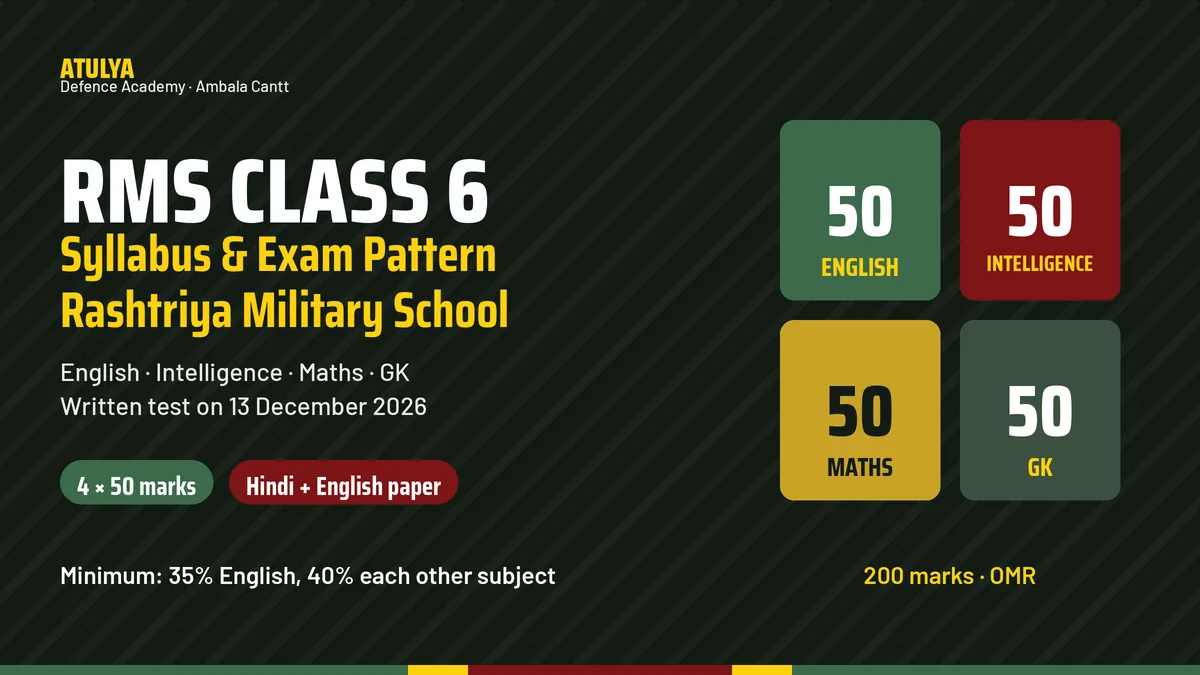
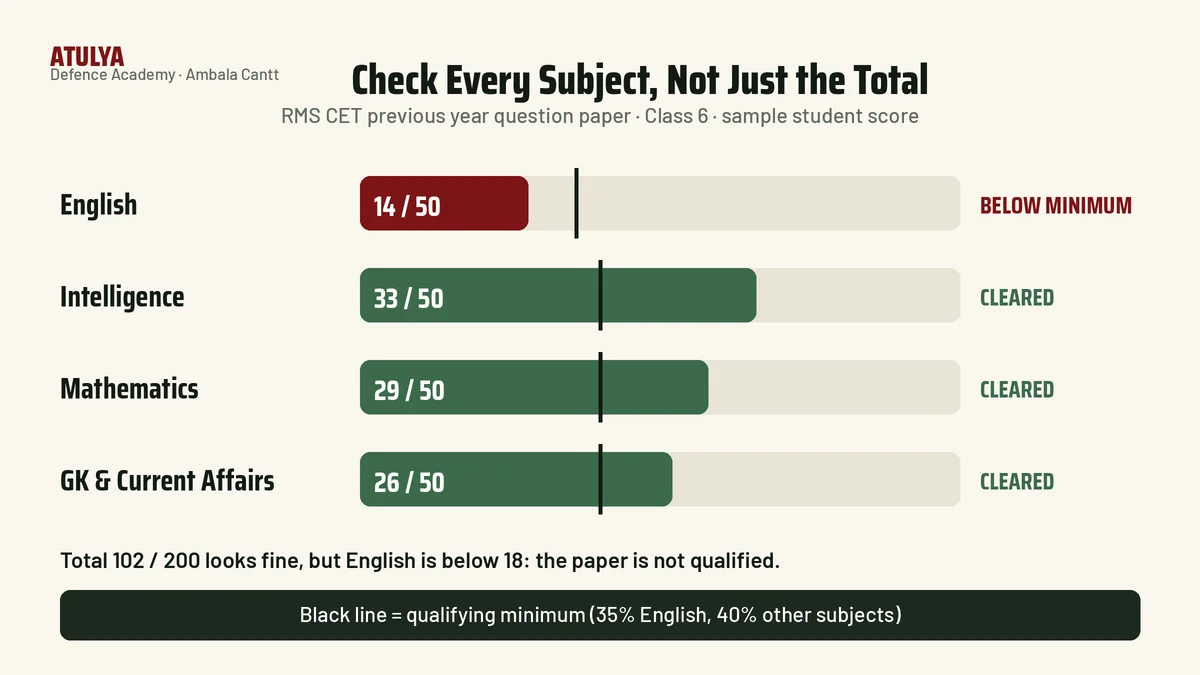
In the Class 6 paper, a child needs at least 35 percent in English and 40 percent in each of Intelligence, Mathematics, and General Knowledge and Current Affairs. All four subjects carry 50 one-mark questions. So a total of 140 out of 200 can still be a fail if English is at 15. After each attempt, the first number to look at is the lowest subject score, not the total.
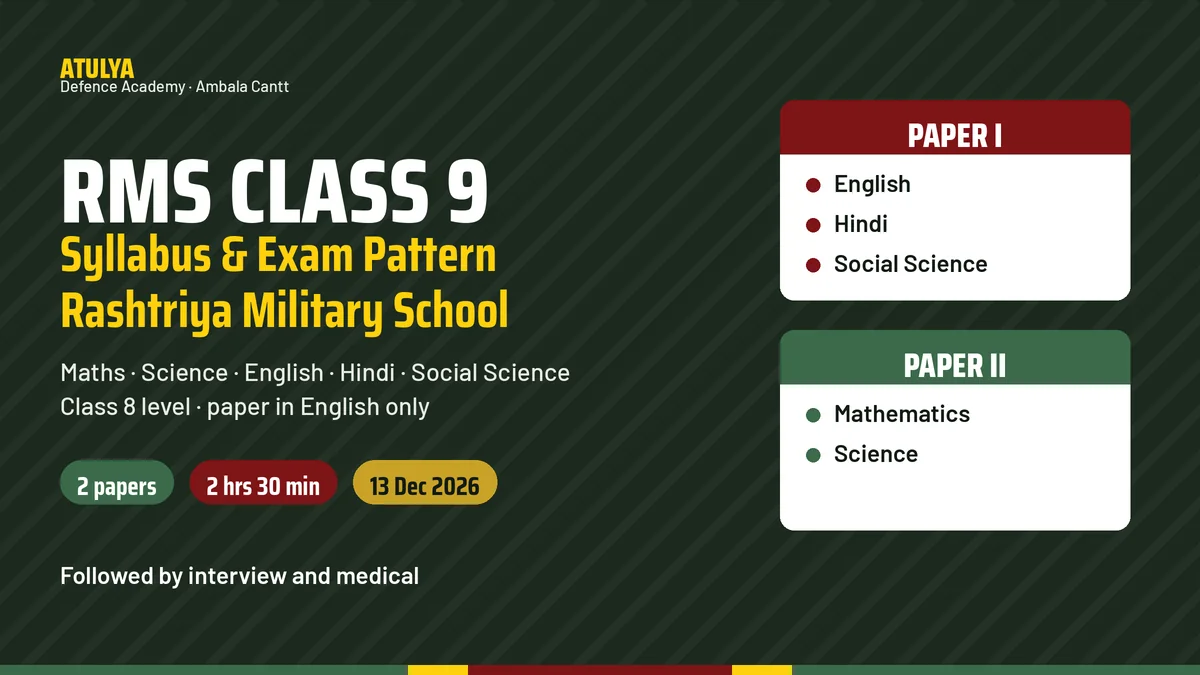
For Class 9, which covers English, Hindi, Social Science, Mathematics and Science across two papers in English, check the current bulletin for the minimum in each and apply the same thinking.
Where to find genuine past tests
- Official sources first. Since the test is now conducted by the National Testing Agency, check the NTA portal for sample questions in the information bulletin's sample questions. The Rashtriya Military Schools' websites have also carried sample sets in some years.
- Solved collections. Most families use solved collections sold by publishers. Pick one that labels each test by year, matches the current four-subject Class 6 format (or the two-paper Class 9 format), and explains the reasoning answers with diagrams.
- Coaching sets. Papers reconstructed from memory after the exam are common online. Treat them as extra practice, not as the main set; figures and options are often incomplete.
About the RMS question paper PDF class 6 copies online
Files labelled as a Class 6 question paper PDF circulate widely on messaging groups. Some are scans of real papers, many are retyped with errors, and a few belong to the old pattern from before the current subject structure. Before using one, check that it has 50 questions in each of the four subjects. If it does not, it is from an older format and should be used only for topic practice.
Where can RMS answer keys be found?
For the current test, check the NTA portal after 13 December for any provisional answer key and the window to challenge it. For older papers, the RMS answer key you will find is the one printed in the solved book, prepared by the publisher. Those keys are mostly reliable, but we find occasional errors in reasoning and GK answers, especially where facts have changed (a sports champion, an award winner). When a child is confident about an answer the key marks wrong, check it together before accepting the key.
How many RMS papers should a child practise?
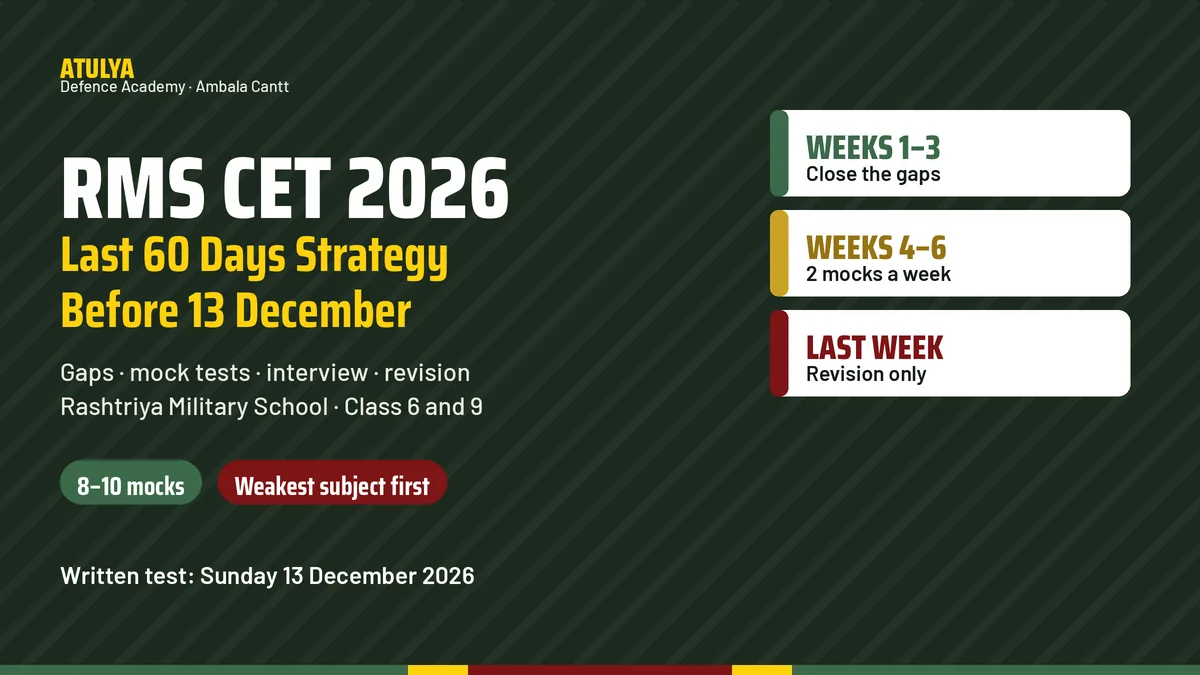
Eight to ten complete tests before 13 December is the target we set. With about seven weeks left from late October, that means roughly one a week at first and two a week in the last month. Every attempt needs a review day after it, so trying to do more usually means doing them badly. If a child has already solved the genuine ones available, add an RMS model paper from a reputable publisher, but treat its score with caution; model papers are often easier or harder than the real thing.
The review that makes each attempt count
Score by subject
Write four numbers (English, Intelligence, Maths, GK) and mark any that fall below the qualifying line in red.
Sort the mistakes
For each wrong or blank answer: not known, misread, ran out of time, or careless. Count each group.
Pick two fixes
Only two, so they actually get done. For example: prepositions and articles in English; coding-decoding in Intelligence.
Three days of targeted practice
20 to 30 minutes a day on each fix, then the next paper.
Children who follow this loop six or seven times usually see the weakest subject climb steadily. Those who skip the review and keep solving new ones see their totals bounce up and down without a clear trend.
RMS class 9 previous paper: what is different
For Class 8 students, old tests reveal one thing very quickly: reading speed in English matters in every subject, because science and social science questions are written in English too. Use the first two attempts to time how long the child takes per question in each section. If science is slow because of the wording, add ten minutes of reading science text aloud each day. Keep a list of English terms that cause trouble (photosynthesis, friction, constitution, judiciary) and revise it weekly. Hindi, often neglected, is worth a quick grammar revision because its marks are easy to secure.
A seven-week plan to the test
| Weeks | Papers | Focus |
|---|---|---|
| 1–2 | 1 per week (oldest) | Find the weakest subject; fix basics |
| 3–4 | 1–2 per week | Weakest subject above its minimum |
| 5–6 | 2 per week (most recent) | Speed, OMR accuracy, interview practice |
| 7 | 1, early in the week | Mistake notebook and light revision only |
What old tests reveal, subject by subject
English
Grammar carries most of the section: articles, prepositions, tenses, subject-verb agreement, plus synonyms and antonyms. Reading passages are short. Children who read a little English every day rarely struggle; those who do not often sit just under the 35 percent line.
Intelligence
Number and letter series, coding-decoding, analogies, odd one out and figure-based questions dominate. Fifty questions is long, so stamina and a steady pace matter as much as skill.
Mathematics
Class 5 word problems on money, time, percentage, profit and loss and simple interest, with some geometry and measurement. Since every question is worth one mark, speed on simple items pays.
GK and current affairs
A broad spread: India's geography and history, science of daily life, sports and awards, and a noticeable share on the armed forces, from ranks to gallantry awards. Current affairs from the past year matter.
A worked review from our batch
One of our Class 5 students, a girl from a Hindi-medium school, scored 14 in English, 33 in Intelligence, 29 in Maths and 26 in GK on her second practice test. Her total, 102, looked reasonable, but English was below the qualifying 18. Her review showed nine errors on prepositions and articles, four on unfamiliar words in the passage, and a section left half-finished because she had started with English and slowed down.
Her fixes for the next three days: fifteen minutes of preposition and article drills, one short passage read aloud, and a new section order starting with Intelligence. On the next attempt she scored 21 in English, safely above the line, with the other subjects steady. The total rose only a little; the result changed completely.
Setting up a mock at home
Choose a time close to the real reporting time, clear the table, print an OMR sheet, and keep a wall clock visible. The parent collects the booklet at the end and marks it that evening, using the key, with the child watching. Treat each attempt the way you will treat the real day, and the real day will feel familiar. Used like this, each RMS CET previous year question paper becomes a rehearsal rather than homework.
When to stop solving and start revising
From about six days before the test, stop taking full attempts. By then the child has seen the format many times, and a poor score that close to the exam does more harm than good. Spend the last days on the mistake notebook, the vocabulary list, a one-page maths formula sheet, and current affairs from the past few months. The final RMS CET previous year question paper should be the most recent year's, solved early in that last week, and treated as a confidence check rather than a test of new learning.
RMS ki taiyari kaise karein?
Purane prashn-patra sabse kaam ki cheez hain, par sirf hal karna kaafi nahi. Har paper ke baad har subject ke number alag likhein, dekhein kaunsa minimum se neeche hai, aur agle teen din usi par kaam karein. English roz padhein, kyunki ek bhi subject fail hua to baaki number kaam nahi aate.
Facts about the test
What is the RMS CET exam date?
Sunday, 13 December 2026, in pen-and-paper OMR mode for both classes. Details are in our 2026 entrance guide.
What is the RMS Class 6 exam pattern?
Four subjects, 50 questions and 50 marks each: English, Intelligence, Mathematics, and General Knowledge and Current Affairs, with the question paper in Hindi and English. The topics are listed in our Class 6 syllabus guide.
How many Rashtriya Military Schools are there?
Five, at Chail, Ajmer, Dholpur, Belgaum and Bengaluru.
Who can apply to RMS?
Children born between 1 April 2014 and 31 March 2017 who are in Class 5 (for Class 6), and between 1 April 2011 and 31 March 2014 who are in Class 8 (for Class 9). Children of service personnel and of civilians can apply.
Can civilians get admission in RMS?
Yes, though most seats are reserved for wards of JCOs and other ranks. Officers' wards and civilians compete for the rest, so civilian children usually need a higher merit position.
Which RMS is nearest to Punjab and Haryana?
Chail, in Himachal Pradesh, around four hours by road from Ambala Cantt.
What is the age limit for RMS Class 6 and 9?
10 to 13 years for Class 6 and 13 to 16 years for Class 9, counted on 31 March 2027, with six months' relaxation in the upper limit for wards of personnel killed in action.
Practise with us
Every Sunday until 13 December, our Ambala Cantt campus runs a full past paper on OMR sheets, followed by a subject-by-subject review the next day. Call 98121-97229 or see our sample papers page.
Sources
- National Testing Agency, RMS CET 2026 notice and information bulletin: exams.nta.nic.in/rmscet
- Rashtriya Military Schools, Ministry of Defence: rashtriyamilitaryschools.edu.in
Pattern and rules as per the NTA notice, checked on 22 October 2026.