Ask any teacher who has coached children for the JNV entrance what the single most useful study material is, and the answer is almost always the same: old papers. Not because the same questions come back, but because nothing else shows a child the real level, the real wording and the real speed of the test so clearly. A child who has solved eight or ten past papers under the clock walks into the exam hall knowing exactly what the booklet will feel like.
The catch is that most families use old papers badly. They download a stack, the child solves a few at leisure over the weekend, nobody checks the mistakes, and the papers run out three weeks before the test. This guide sets out how to use each Navodaya previous year question paper properly, how many to use, where to find genuine ones, and how to read an answer key.
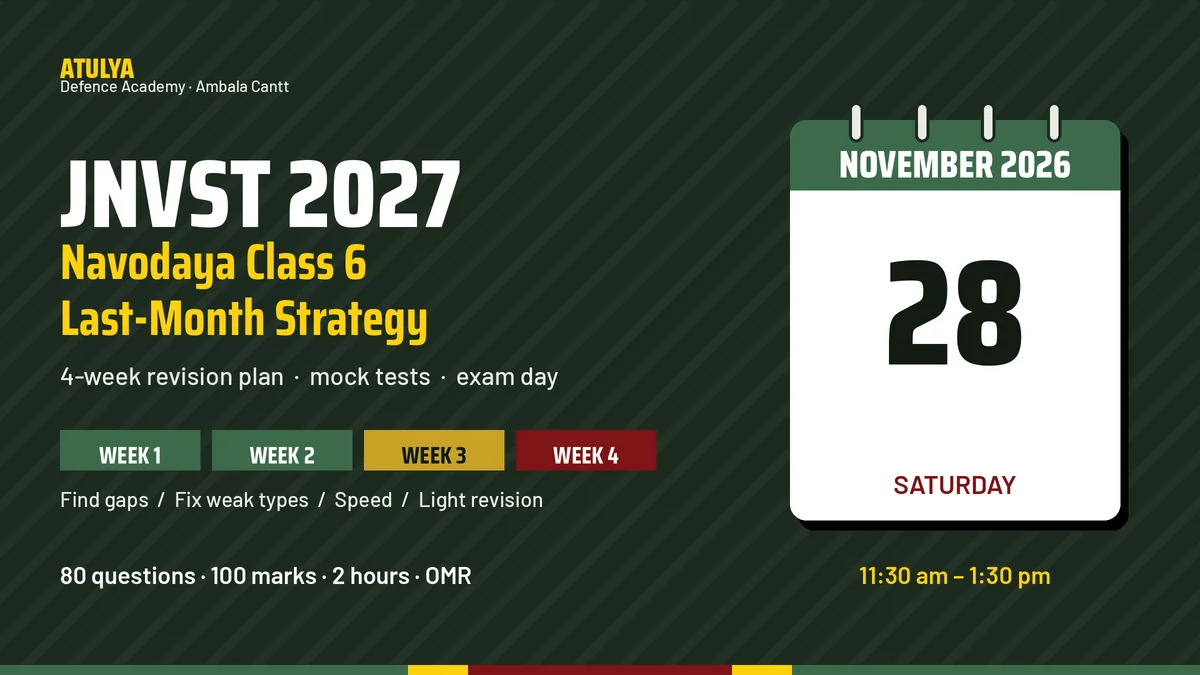
The method in one line: one past paper at a time, under real test conditions (2 hours, OMR sheet, 11:30 am start), marked the same day, and followed by a full session on the mistakes before the next paper is attempted.
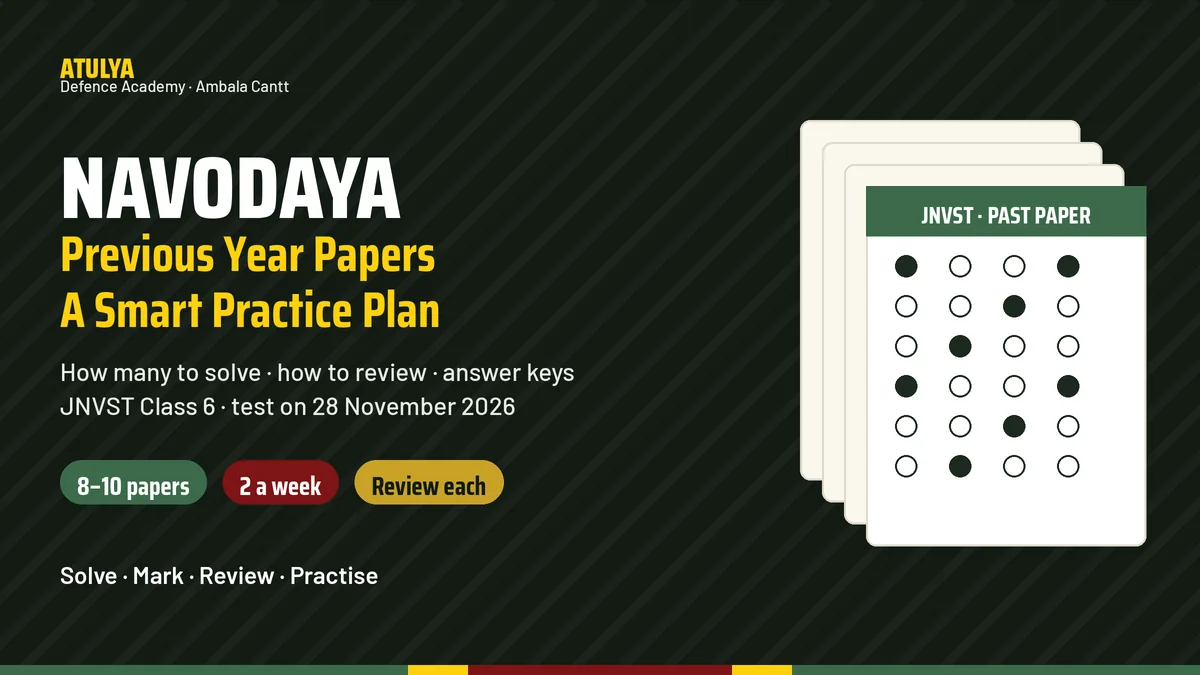
How many years of JNVST papers to practise?
Eight to ten years of old tests is a good target. That gives enough variety in the mental ability figures and the reading passages without repeating the same paper so often that a child memorises answers. With about five weeks left before 28 November, that works out to two a week, which is the right pace: one test, one day of correction, and three or four days of targeted practice on the weak question types before the next attempt.
If time is shorter, do fewer properly rather than more carelessly. Five with honest correction beat fifteen solved and forgotten.
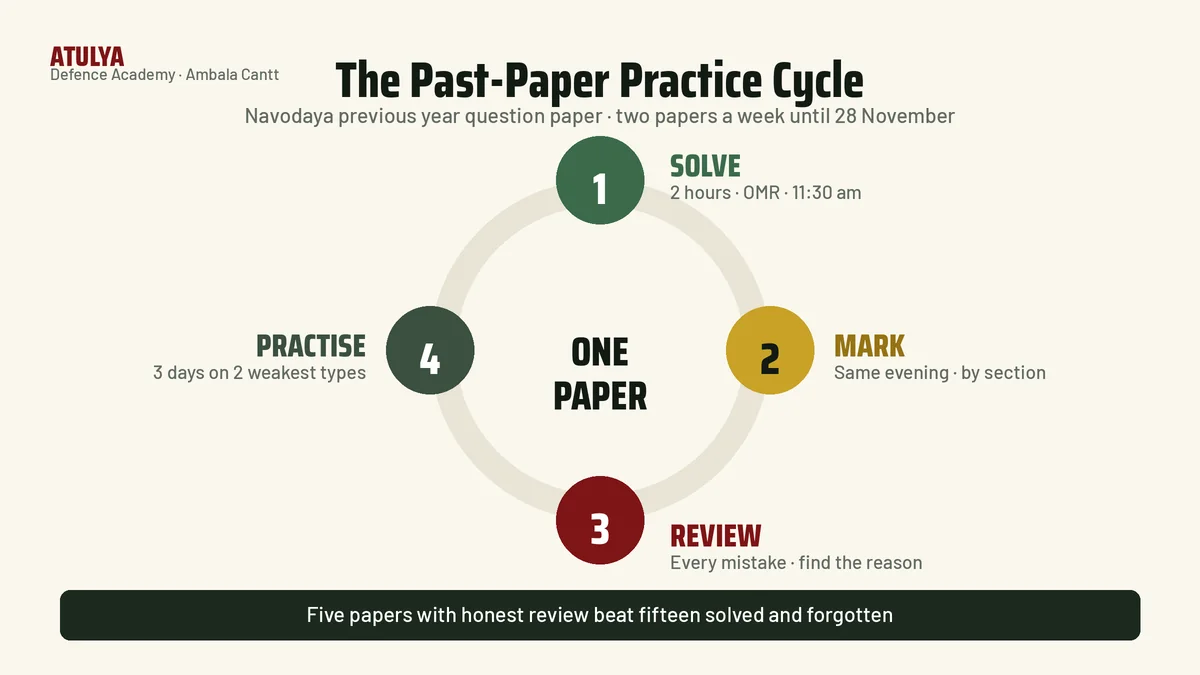
The four-step cycle for each paper
Solve under real conditions
Same start time as the test, 11:30 am, at a clear table. Two hours, no breaks except the washroom, no help. Answers shaded on a printed OMR sheet, not ticked in the booklet.
Mark the same day
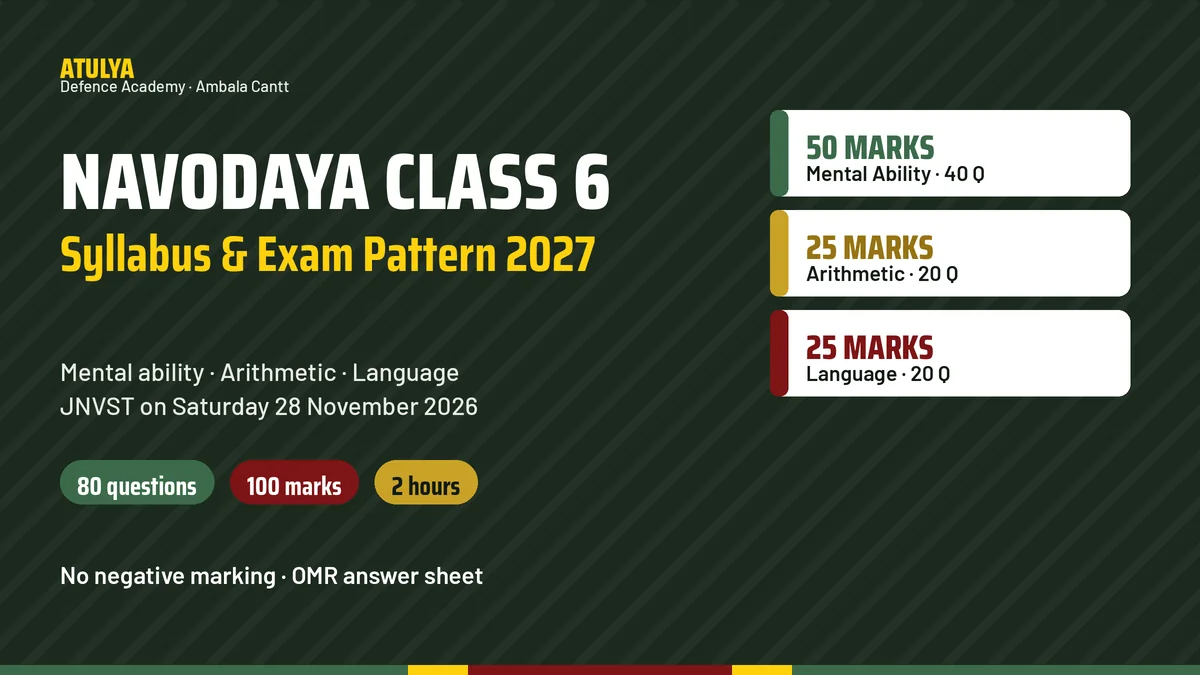
Use the answer key to mark the sheet that evening. Write the score section by section: mental ability out of 50, arithmetic out of 25, language out of 25.
Review every mistake
Next day, go through each wrong or skipped question with the child. For each, write the question type and the reason: did not know, misread, ran out of time, or careless. That reason decides the fix.
Targeted practice
Spend the next three days on the two weakest question types only, using a practice book. Then attempt the next paper.
Where to find genuine papers
The Navodaya Vidyalaya Samiti puts sample question booklets on navodaya.gov.in, and district JNVs sometimes share old tests with schools and parents. Beyond that, most families rely on solved collections sold by publishers. These are useful, but check two things before buying: that each test is labelled by year and matches the current 80-question format, and that the explanations for figure questions are drawn, not just stated.
Be careful with a "JNVST question paper PDF" passed around on messaging apps. Many are reconstructed from memory by coaching centres after the test, with figures redrawn badly and some questions missing. They are fine for extra practice but should not be the main set.
Are JNVST papers available in Hindi?
Yes. The test is held in English, Hindi and several regional languages, so old tests and solved books exist in Hindi as well. A child should practise in the same language they have chosen in the application form, especially for the language test, where the passages are written in that language.
Reading the answer key
Keys printed in solved collections are prepared by the publishers. They are mostly correct, but for figure questions we find the occasional error. When the child is sure of an answer that the key marks wrong, work it out together; if it still looks right, ask a teacher before accepting the key. A child who loses confidence in a correct method because of a wrong key is worse off than one who never saw the key. NVS does not always release an official answer key, so the printed JNVST answer key in a book is a guide, not the final word.
Tracking scores across tests
Keep a simple table on the fridge or the study wall. Children like to see the line go up, and parents can spot a stuck section early.
| Paper | Mental ability (50) | Arithmetic (25) | Language (25) | Total (100) |
|---|---|---|---|---|
| Paper 1 | __ | __ | __ | __ |
| Paper 2 | __ | __ | __ | __ |
| Paper 3 | __ | __ | __ | __ |
As a working target, children in our batches aim to cross 75 out of 100 consistently in the last two weeks. That leaves a margin for a difficult paper or nerves on the day. If one section stays flat for three attempts in a row, change the practice for it rather than adding more full tests.
Solved past tests versus model papers
A Navodaya model paper is written by a publisher or coaching centre to resemble the test. Navodaya class 6 solved papers are the real past tests with worked answers. Use the real ones first and keep the model sets for the last ten days, when the child has seen all the genuine ones. They vary in quality: some are harder than the real test, which can shake a child's confidence just before the exam. If a model set feels very different from the real tests, do not read too much into a low score on it.
What past tests tell us about the exam
After sorting a decade of old JNVST booklets in our staff room, a few patterns stand out. In mental ability, rotation by 90 or 180 degrees and changes in the number of small elements (dots, lines, arrows) drive most of the figure series and analogy questions. In arithmetic, money, time and simple word problems on fractions turn up every year, while area and volume usually appear as one or two straightforward questions. The reading passages are short pieces of narrative or simple non-fiction, with questions that ask what happened, why, and what a word means in that sentence. Knowing this helps a child read a question and recognise its type in a few seconds, which is where speed comes from.
A five-week schedule to 28 November
| Week | Past tests | Focus between tests |
|---|---|---|
| Week 1 (to 29 Oct) | 2 (oldest years) | Find the three weakest figure types |
| Week 2 | 2 | Those three types daily; fractions and division speed |
| Week 3 | 2 | One reading passage a day; mirror and punched-hole sets |
| Week 4 | 2 (most recent years) | Mistake notebook only; OMR speed |
| Week 5 (to 27 Nov) | 1, early in the week | Light revision, early sleep, admit card ready |
Keep the two most recent years for week 4. They are the closest to what the child will face, and a good score on them just before the test gives confidence.
What a mistake review looks like
Here is a typical review from one of our Class 5 students after his third practice test. He scored 34 in mental ability, 19 in arithmetic and 21 in language. Of his six wrong figure questions, four were punched-hole patterns and two were mirror images. In arithmetic, two errors were careless (he copied 48 as 84), and two were genuine gaps in percentage. In language, both mistakes came from the same passage, where he had guessed the meaning of an unfamiliar word without reading the sentence around it.
So the next three days were simple: twenty punched-hole and mirror questions a day, ten percentage problems, and a habit of reading the whole sentence before answering a word-meaning question. His next Navodaya previous year question paper gave him 41, 21 and 22. Nothing dramatic, just the specific fixes.
How parents can help without hovering
A ten-year-old does not need a parent beside them for two hours. What helps is structure: setting up the table, the timer and the OMR sheet; collecting the booklet at the end; and sitting together the next evening for twenty minutes to go through the errors. Praise the corrections, not just the score. A child who learns that a bad test leads to a calm review, not a scolding, keeps taking these practice tests honestly. A child who fears the result starts to look at the key early or leave hard questions blank.
Used this way, each Navodaya previous year question paper becomes a lesson rather than just a score.
Navodaya ki taiyari kaise karein?
Purane prashn-patra sabse achhi taiyari hain. Hafte me do, asli samay me OMR sheet par, usi din number, aur agle din har galti par baat. Beech ke dinon me sirf kamzor prakar ke sawalon ki practice karein.
Quick facts about the test
When is the JNVST 2027 exam?
Saturday, 28 November 2026, from 11:30 am to 1:30 pm, for admission to Class 6 in 2027-28.
What is the JNVST exam pattern?
Eighty multiple-choice questions for 100 marks: mental ability (40 questions, 50 marks), arithmetic (20 questions, 25 marks) and language (20 questions, 25 marks), with no negative marking. The section-wise syllabus is in our Navodaya Class 6 syllabus guide.
Who is eligible for Navodaya Class 6?
Children born between 1 May 2015 and 31 July 2017 who are studying Class 5 in 2026-27 in a government or recognised school in the district of the JNV, having passed Class 3 and 4.
How does the Navodaya rural quota work?
A minimum of three-quarters of each district's seats go to children who studied Class 3, 4 and 5 for full sessions in rural schools. The rest are open to every eligible child.
Can a student apply to JNV outside the home district?
No. The application is only for the JNV of the district where the child studies Class 5.
What is the JNVST cut off?
No single figure exists. Merit lists are drawn up district by district within rural, urban, gender and category groups, so the score needed changes from one district to another.
When will the Navodaya result come?
Around March to April 2027, on navodaya.gov.in and at the district JNV.
Sit a past paper in exam conditions
Every Sunday until 28 November, our Ambala Cantt campus runs a past test under real timing on OMR sheets, with a section-wise report. Call 98121-97229 or read our last-month JNVST plan.
Sources
- Navodaya Vidyalaya Samiti, JNVST 2027 prospectus and sample papers: navodaya.gov.in
- NVS admission portal: cbseitms.rcil.gov.in/nvs
Exam details as per NVS, checked on 22 October 2026.