Families preparing for the Sainik School paper often add the military school test to their list late, assuming one preparation covers both. It mostly does, but not entirely. The Class 6 paper for the five Rashtriya Military Schools gives English and General Knowledge the same weight as Mathematics, and it asks for a minimum score in every subject. A child who is strong in maths but weak in English can clear the Sainik School cut-off and still fail this one.
This guide sets out the Rashtriya Military School Class 6 syllabus subject by subject, explains the marking and the qualifying rules, and gives a plan for the weeks before the written test on 13 December 2026.
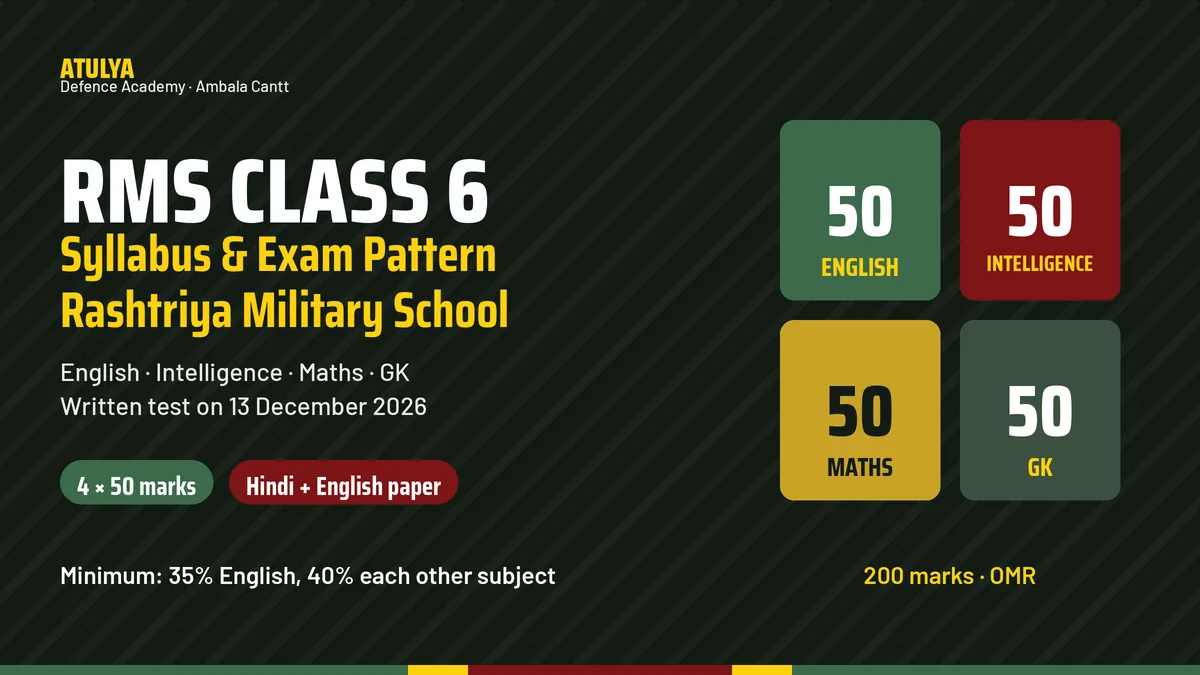
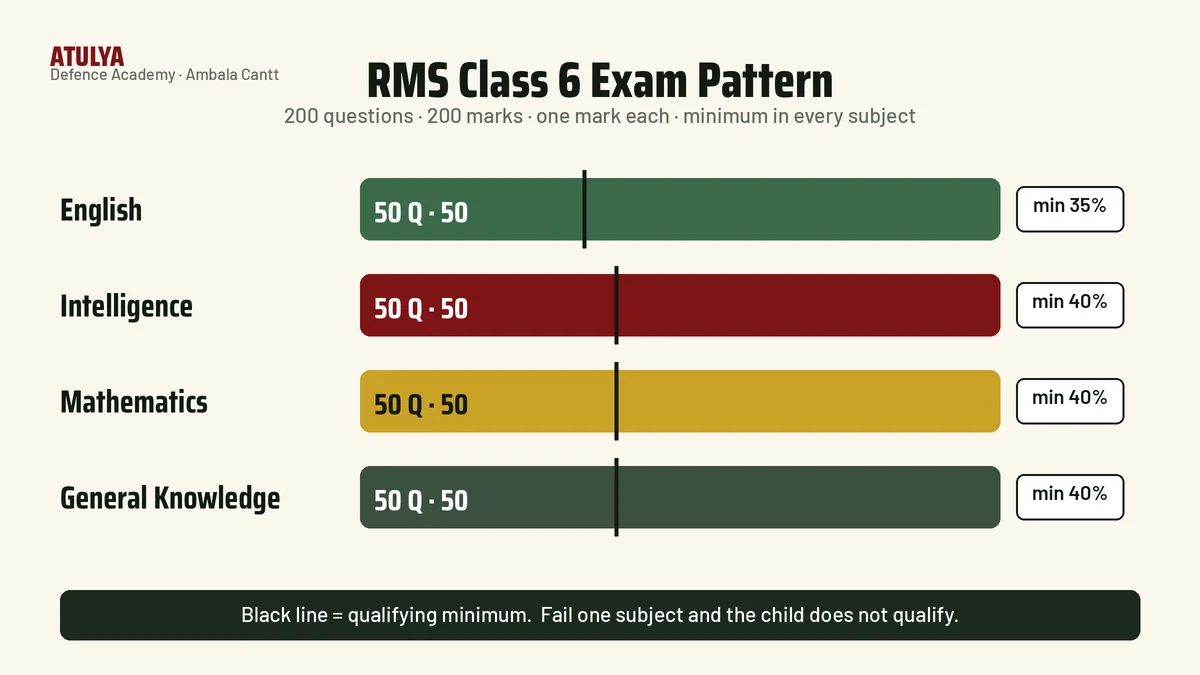
At a glance: four subjects with 50 questions and 50 marks each, 200 marks in total, objective type on an OMR sheet, question paper in Hindi and English. Minimum 35 percent in English and 40 percent in each of the other three subjects to qualify.
What is the RMS Class 6 exam pattern?
| Subject | Questions | Marks | Qualifying minimum |
|---|---|---|---|
| English | 50 | 50 | 35% (18 marks) |
| Intelligence Test | 50 | 50 | 40% (20 marks) |
| Mathematics | 50 | 50 | 40% (20 marks) |
| General Knowledge and Current Affairs | 50 | 50 | 40% (20 marks) |
| Total | 200 | 200 | All four must be cleared |
How many sections are in the RMS Class 6 paper?
Four, each with 50 one-mark questions. That makes this RMS CET Class 6 exam pattern simpler to plan for than the Sainik School paper, where maths questions carry three marks each. Here every correct answer counts the same, so a quick GK question is worth exactly as much as a long maths problem. Children should answer the easy ones in all four sections first and come back to the hard ones.
Is the RMS Class 6 paper of Class 5 standard?
Broadly, yes. The maths and English are at the level of a good Class 5 CBSE or state board student, with a few questions that stretch into early Class 6 work. The GK section ranges wider, because current affairs and general awareness are not tied to any textbook. A child who has done well in Class 5 school exams already has most of what the maths and English sections need; speed and accuracy are what the extra preparation adds.
Rashtriya Military School Class 6 syllabus, subject by subject
RMS class 6 maths syllabus
Numbers
- Number system, place value, large numbers
- Operations on whole numbers
- Factors, multiples, prime numbers
- LCM and HCF
- Fractions and decimals
- Roman numerals
Everyday maths
- Unitary method
- Ratio and proportion
- Percentage
- Profit and loss
- Simple interest
- Money, time, calendar
- Measurement of length, weight, capacity
Shapes and data
- Lines, angles and their types
- Triangles, quadrilaterals, circles
- Perimeter and area
- Volume of cube and cuboid
- Reading tables, bar graphs, pictographs
RMS class 6 English
Expect one or more reading passages and a large set of grammar and vocabulary questions:
- Reading comprehension
- Articles and prepositions
- Nouns, pronouns, adjectives, adverbs
- Verbs and tenses
- Subject-verb agreement
- Singular-plural, gender
- Synonyms and antonyms
- One-word substitution
- Spelling correction
- Sentence arrangement
- Common idioms
- Question tags and punctuation
English deserves special attention here. The schools teach in English from Class 6 onward, and the paper is designed to check whether a child can cope with that. Children from Hindi-medium schools should start reading short English stories aloud every day; fifteen minutes daily for eight weeks makes a visible difference.
RMS class 6 intelligence
Verbal and non-verbal reasoning: analogy, odd one out, number and letter series, coding-decoding, direction sense, blood relations, ranking and order, mirror and water images, paper folding and cutting, embedded figures, pattern completion, counting figures, and Venn diagrams. With 50 questions, this section has twice as many reasoning questions as the Sainik School paper, so stamina matters. Practise in sets of 25 against a 20-minute timer.
General Knowledge and Current Affairs
Static GK
- Science: plants, animals, human body, food, health, environment
- India: states and capitals, rivers, mountains, national symbols
- History and culture: freedom fighters, monuments, festivals
- Indian Army, Navy and Air Force: ranks, insignia, famous battles and gallantry awards
Current affairs
- Major national and international events of the past year
- Sports: tournaments, winners, venues
- Awards and honours
- Books and authors, important days
- Space missions and new government schemes
The defence-related GK is where children from service families often have an edge; civilian children should spend a few sessions on ranks, regiments and the services' history.
Sample questions in the style of the paper
These are written by our faculty to show the level, not copied from any past paper. Try them with your child under a two-minute limit for all eight.
1. A shopkeeper buys a toy for ₹240 and sells it for ₹300. What is his profit per cent? (a) 20% (b) 25% (c) 60% (d) 15%
2. The LCM of 12 and 18 is: (a) 6 (b) 24 (c) 36 (d) 72
3. Choose the correct word: She is fond ___ music. (a) of (b) at (c) with (d) in
4. The opposite of "ancient" is: (a) old (b) modern (c) rare (d) huge
5. Find the next number: 3, 6, 12, 24, ? (a) 30 (b) 36 (c) 48 (d) 42
6. If PEN is written as QFO, how is INK written? (a) JOL (b) JML (c) HOL (d) JOK
7. The highest wartime gallantry award in India is the: (a) Ashoka Chakra (b) Param Vir Chakra (c) Vir Chakra (d) Kirti Chakra
8. Which gas do plants take in to make food? (a) Oxygen (b) Nitrogen (c) Carbon dioxide (d) Hydrogen
Answers: 1 (b), 2 (c), 3 (a), 4 (b), 5 (c), 6 (a), 7 (b), 8 (c).
How this paper differs from the Sainik School paper
| Point | Military school test | Sainik School test |
|---|---|---|
| Exam date | 13 December 2026 | 31 January 2027 |
| Total marks | 200 (4 × 50) | 300 (maths alone 150) |
| Marks per question | 1 in every section | 3 in maths, 2 elsewhere |
| Age window | 10 to 13 years | 10 to 12 years |
| After the written test | Interview and medical | E-counselling and medical |
The practical lesson: a child preparing for both should push English and GK harder in October and November for the December paper, then shift weight back to maths in December and January for the Sainik School paper.
Books and material that are enough
NCERT Class 5 maths and EVS, and a Class 5 English grammar book, cover the base of the Rashtriya Military School Class 6 syllabus. Add one book of solved previous papers, one reasoning practice book, and a children's news source for current affairs. More books do not mean more marks. What children need in the last two months is timed practice and a careful look at what they got wrong.
RMS ki taiyari kaise karein?
Chaaron subject ke number barabar hain, isliye roz chaaron ko samay dein: 30 minute maths, 25 minute English, 20 minute reasoning, 15 minute GK. Hafte me ek poora paper OMR sheet par, aur har subject me minimum number par khaas nazar rakhein.
Eight-week plan to the 13 December paper
One full paper to find the weakest subject. English grammar basics, maths numbers and fractions, 25 reasoning questions a day.
Maths everyday topics, English vocabulary lists, reasoning figure types. GK: one topic a day plus news.
Shapes and data in maths. Two full papers a week on OMR sheets. Track each section against its qualifying minimum.
Only mistakes and revision. Interview practice: speaking in English about family, school and hobbies.
A note on the qualifying minimum
Because a child must clear every section, the weakest subject decides the result more than the strongest. After each mock, look first at the lowest section score, not the total. A child scoring 42 in maths and 15 in English has failed, even with a respectable total; the same child at 35 in maths and 25 in English has qualified. In the last four weeks, give the weakest section an extra twenty minutes every day until it sits safely above its minimum, then return to a balanced timetable.
What happens after the RMS written test?
Children who qualify are called for an interview and a medical examination. The final merit is drawn from the written marks and the interview, within each category of seats. Medical fitness is required for admission. The interview for Class 6 is short and conversational; the panel wants to see a child who can talk in simple English and is not overwhelmed by a new setting.
Seats, age and fees
Can civilians get admission in RMS?
Yes, though most seats are kept for wards of Junior Commissioned Officers and other ranks. Children of officers and of civilians compete for the remaining seats, so the merit needed for a civilian seat tends to be higher.
What is the age limit for RMS Class 6 and 9?
For the entry-level class, the child must be 10 to 13 years old on 31 March 2027, that is, born between 1 April 2014 and 31 March 2017. For Class 9, 13 to 16 years, born between 1 April 2011 and 31 March 2014. Wards of personnel killed in action get six months' relaxation in the upper limit.
Which RMS is nearest to Punjab and Haryana?
The Chail school in Himachal Pradesh, about four hours by road from Ambala Cantt. Ajmer and Dholpur in Rajasthan are the next nearest of the five.
What are RMS fees?
Fees depend on the category of the parent. Wards of JCOs and other ranks pay the lowest fee, officers' wards pay more, and civilian children pay the highest rate. The schools publish the current fee schedule in their prospectus and on the admission pages of their websites. Ask the school for the 2027-28 figures, including the one-time charges at admission, rather than relying on old numbers shared online.
Is RMS better than Sainik School?
It depends on the child and the family. The military schools are fewer, smaller and run directly under the Army, with most seats for service families. Sainik Schools are many more, spread across states, with a home-state quota. Since the papers share much of their content and fall on different dates, most families we advise apply to both. See our Sainik School Class 6 syllabus for the second paper.
Practise on the real pattern
We run Sunday mocks on the military school pattern at our Ambala Cantt campus until 13 December, with a section-wise report against each qualifying minimum. Call 98121-97229, read the 2026 entrance guide, or see our coaching programme.
Sources
- National Testing Agency, RMS CET 2026 notice and information bulletin: exams.nta.nic.in/rmscet
- Rashtriya Military Schools, Ministry of Defence: rashtriyamilitaryschools.edu.in
- NCERT Class 5 textbooks: Mathematics, English and EVS
Pattern and rules as per the NTA notice, checked on 17 October 2026.