Every October a group of parents walks into our office with the same worry. The Sainik School notice is out, the paper is on 31 January, and their child has done nothing beyond regular school work. They want to know if it is too late. Usually it is not. Three months is short, but it is enough for a child with a sound Class 4 and 5 base, provided the time goes to the right places and nothing is wasted on chapters that carry two marks.
This is a week-by-week plan for AISSEE preparation in 3 months, written for Class 5 children aiming at Class 6 entry. It assumes about two hours of study on school days and four on weekends. The aim is not to finish every book on the market; it is to be fast and accurate on the questions that actually come.
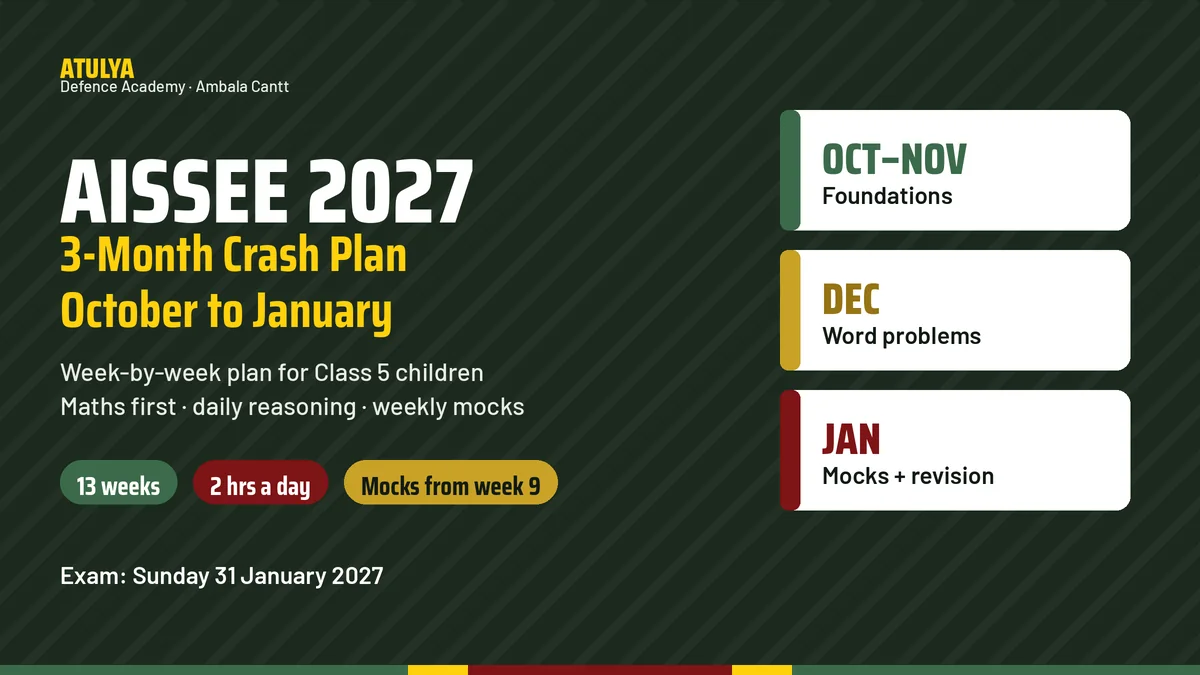
The plan in brief: weeks 1–4 for maths foundations and daily reasoning; weeks 5–8 for word problems, language and GK; weeks 9–12 for full mocks and error correction; the final week for rest and light revision. Maths gets half of all study time because it carries half the marks.
Can AISSEE be cleared in 3 months of preparation?
Yes, for many children. In our experience, the children who clear the paper after a short preparation share three things: they can do basic arithmetic (tables up to 20, fractions, simple division) without hesitation, they read comfortably in the language they choose for the paper, and they practise every single day rather than in bursts. A child who struggles with Class 4 maths needs more than three months, and it is better for the family to know that now and plan for the next year too.
A quick test: give your child twenty mixed Class 5 maths questions and thirty minutes. Fourteen or more correct means a three-month plan is realistic. Below ten means spend the first month only on maths basics, and treat this year's paper as practice if the gap does not close.
How many hours should a Class 5 child study for AISSEE?
About two hours on school days and three to four hours on weekends, split into short blocks. Longer than that, and a ten-year-old stops absorbing anything. We use blocks of 40 minutes with a ten-minute break, because that matches the attention span of most children this age and the pace of the actual paper.
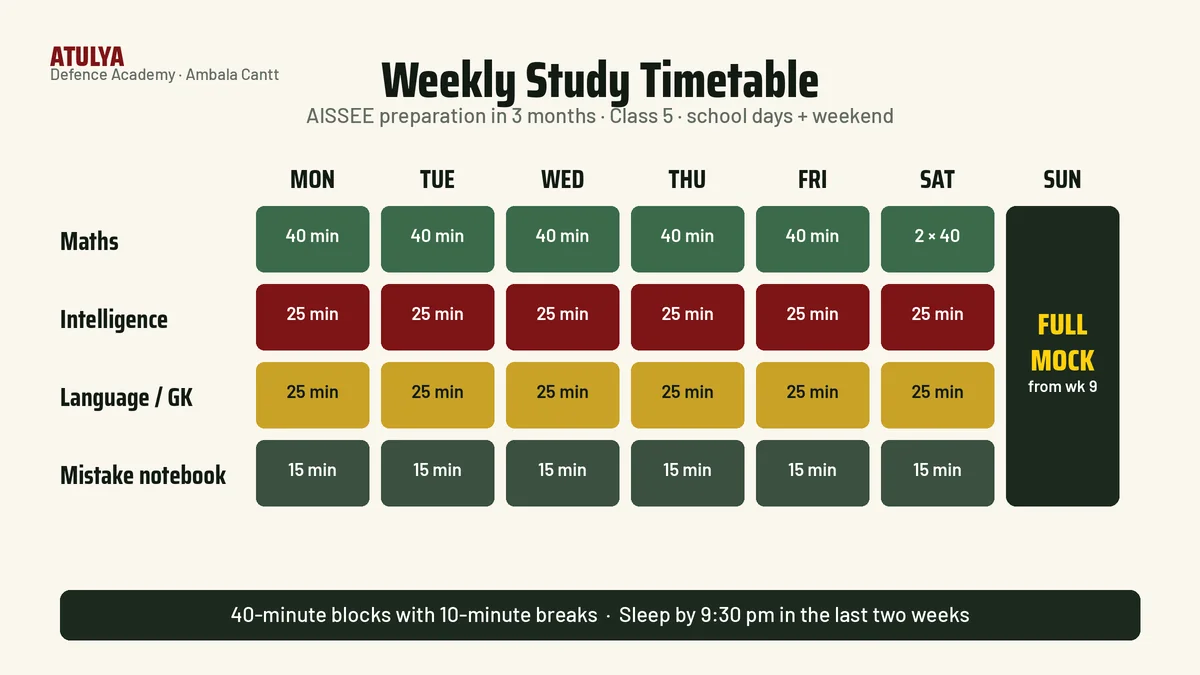
A Sainik School study timetable for school days
| Time block | Subject | What to do |
|---|---|---|
| 40 min | Maths | One topic: concept, 15 solved examples, 10 timed questions |
| 10 min | Break | Away from screens |
| 25 min | Intelligence | 20 questions of one type, timed |
| 25 min | Language or GK (alternate days) | One passage and grammar topic, or one GK chapter |
| 15 min | Mistake notebook | Rewrite today's wrong answers correctly |
On weekends, add a second maths block of word problems and a longer reading session. From week 9, Sunday morning is for a full paper.
The 13-week plan, week by week
Fill the form, test the base
Submit the application first. Give one full previous year paper on day 3 without any preparation, just to see where the child stands. Then start maths: number system, place value, LCM and HCF, factors and multiples.
Fractions and decimals
Fractions, decimals and their operations, because unitary method, percentage, profit and loss all build on them. Intelligence: analogy, classification, number series, coding.
Commercial maths
Unitary method, ratio, percentage, profit and loss, simple interest. Language: comprehension daily, then nouns, verbs, tenses. GK: plants, animals, human body.
Geometry and mensuration
Angles, triangles, perimeter and area, volume of cube and cuboid, unit conversion, Roman numerals. Intelligence: mirror images, paper folding, figure counting. GK: Indian history and geography basics.
First round of full mocks
One full paper every Sunday in 150 minutes on a printed OMR sheet. Monday and Tuesday go to the mistakes from Sunday. Rest of the week: mixed practice on the three weakest topics.
Second round of mocks
Two full papers a week (Wednesday and Sunday). Target: finish maths in 80 minutes so the rest of the paper is not rushed. Revise GK notes and current affairs from the last six months.
Light revision
No new topics. Mistake notebook, formula sheet, early sleep, admit card printed, route to the centre checked.
An AISSEE revision plan that actually sticks
Children forget fastest what they studied once and never saw again. Three habits stop that:
- Mistake notebook: every wrong answer goes in, with the correct method. The notebook, not the textbook, becomes the revision material in the last month.
- Sunday recap: 30 minutes every Sunday on the week's topics, before the mock.
- Spaced repeats: a topic finished in week 3 gets a short ten-question set in week 5, week 8 and week 11.
AISSEE last 3 months strategy: what to skip
With limited time, saying no matters as much as what you study. Skip thick GK yearbooks, chapters beyond Class 5 level that are not in the bulletin, and long handwritten notes. Skip also the temptation to buy a new guide book every two weeks. One good book for maths practice, one for reasoning, and previous year papers are enough. A Sainik School crash course at a coaching centre can help with discipline and timed mocks, but check that it gives children a mock on an OMR sheet every week and goes through each child's mistakes; otherwise it is just more hours in a classroom.
The parent's role in a short preparation
For a ten-year-old, the parent is the timetable. That does not mean sitting beside the child for two hours. It means three small things: making sure the study block starts at the same time every day, checking the mistake notebook every evening for five minutes, and staying calm after a bad mock. A child who scores poorly in week 9 and is scolded will dread week 10. A child who is shown the three topics that cost the most marks and asked to fix just those will improve.
Sleep and food matter more than parents think. Children who sleep by 9:30 pm and eat a proper breakfast score better in mocks than the same children after late nights. In the last two weeks, protect sleep above extra study.
Maths topics ranked for a short preparation
When the clock is short, order matters. This is the priority we follow for AISSEE preparation in 3 months, based on how often each topic appears in past papers and how much it feeds into other questions:
| Priority | Topics | Why |
|---|---|---|
| First | Fractions, decimals, LCM and HCF, unitary method, percentage | Appear every year and are needed for most word problems |
| Second | Profit and loss, simple interest, ratio, area and perimeter, angles | Regular multi-mark word problems |
| Third | Volume of cube and cuboid, unit conversion, temperature, Roman numerals | Quick one-step questions; learn in the last month |
What a healthy mock score curve looks like
Parents often panic at the first full paper. A low start is normal. Here is the kind of progress we see in children who follow the plan honestly, out of 300:
These are typical ranges from our own batches, not guarantees, and every child's curve is different. What matters is the direction. If scores stay flat for two weeks, the mistake notebook is usually not being used; go back to it before adding more practice.
Exam day in brief
- Admit card, a photo ID if asked, two black or blue ball pens, water bottle, and a light snack.
- Reach the centre an hour before reporting time. Walk the child to the gate calmly; no last-minute revision in the car.
- In the paper: start with maths while the mind is fresh, mark answers on the OMR sheet as you go, and fill every bubble before time ends, since there is no negative marking.
- After the paper, do not discuss answers in detail. The result comes weeks later; the child has done the work.
Families who follow this AISSEE preparation in 3 months plan usually find that the last fortnight is the calmest part, because by then the routine runs by itself.
Common questions about the exam
What is the AISSEE 2027 exam date?
Sunday, 31 January 2027, for Class 6 and Class 9. The plan above counts back from that date.
What is the last date to apply for AISSEE 2027?
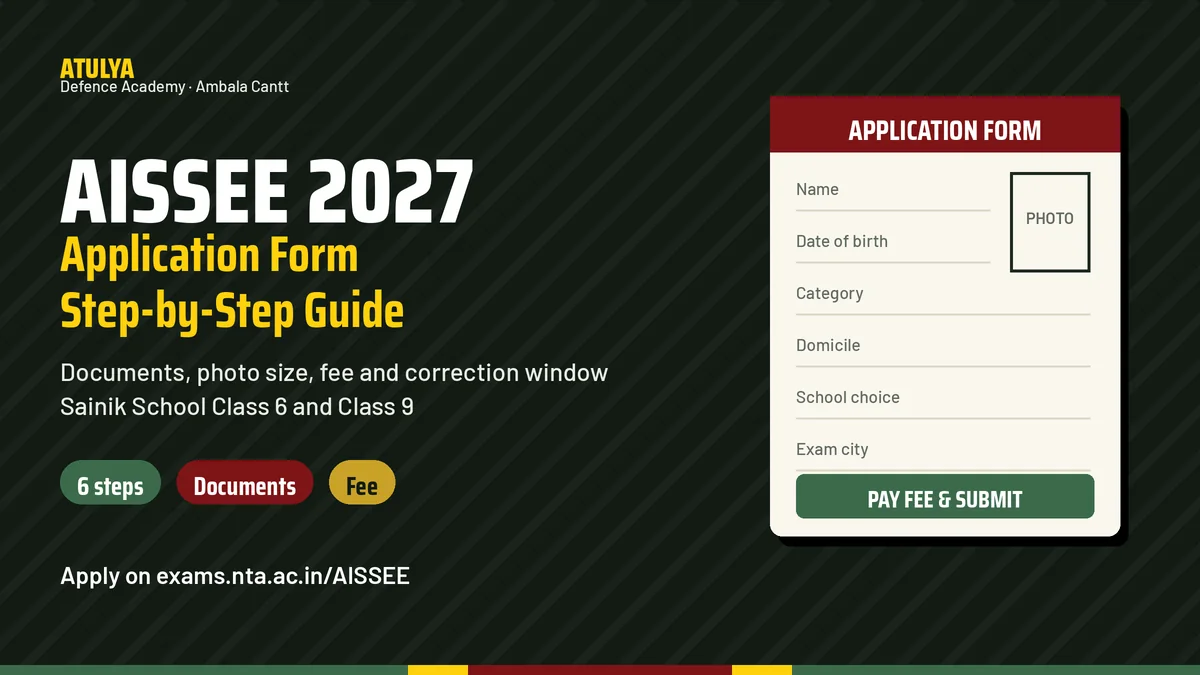
The closing date is in the NTA information bulletin on exams.nta.ac.in/AISSEE. The form opened on 13 October 2026; apply in week 1 of this plan. Our form-filling guide walks through each screen.
Which subjects come in the Sainik School Class 6 exam?
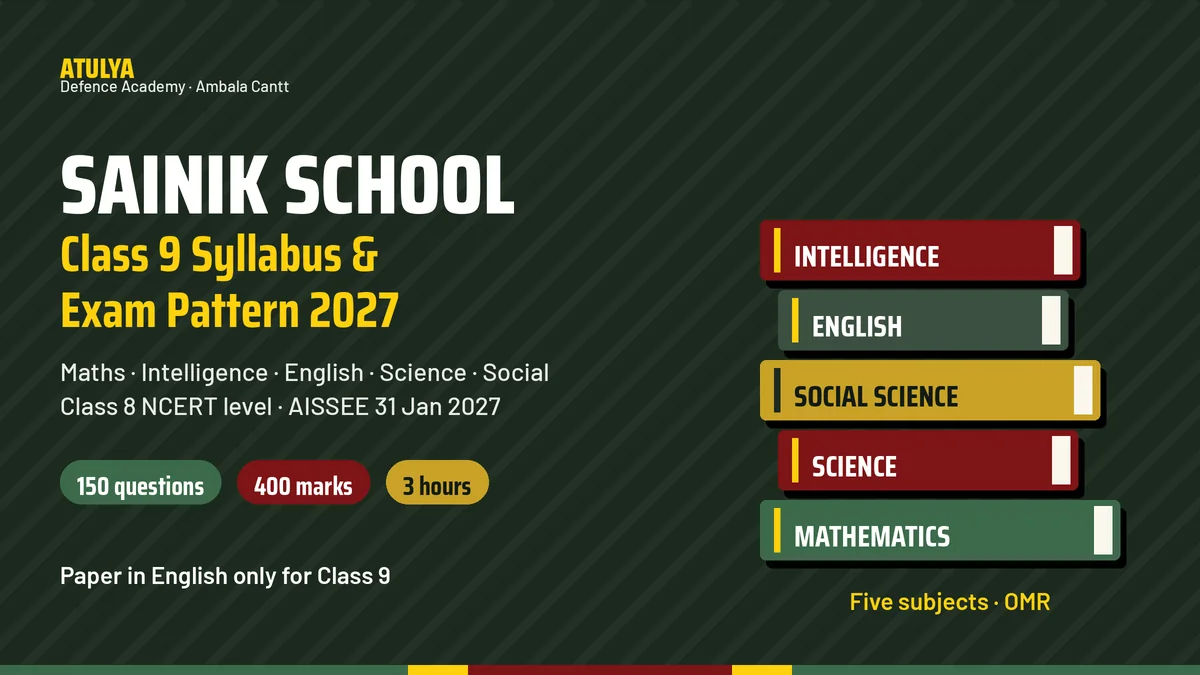
Mathematics (50 questions, 150 marks), Intelligence, Language and General Knowledge (25 questions and 50 marks each). The full topic list is in our Class 6 syllabus guide.
How is the Sainik School merit list prepared?
A child must score at least 25 percent in each subject and 40 percent overall. Qualified children are then ranked within each school by home-state or other-state share, category and the defence quota, and seats are given through e-counselling, a medical test and a document check.
Is coaching necessary for Sainik School?
Not always. What is necessary is the routine in this plan: daily practice, weekly mocks and a careful look at errors. Families who cannot supervise that at home often choose residential coaching. At Atulya, children prepare alongside regular CBSE schooling; details are on our Sainik School entrance programme page.
Sainik School ki taiyari kab se shuru karein?
Aadarsh roop se Class 4 ke aakhir se. Lekin agar sirf teen mahine bache hain, to upar ka plan follow karein: pehle maths, roz reasoning, aur aakhri mahine me har hafte mock test.
How many Sainik Schools are there in India?
33 Sainik Schools under the Sainik Schools Society, along with New Sainik Schools listed in the current bulletin.
Are girls eligible for Sainik School admission?
Yes. Girls can apply for Class 6 in every Sainik School and follow the same plan and the same paper.
Want weekly mocks with feedback?
Our Sunday mock at Ambala Cantt follows the real paper and timing, with a section-wise report and a teacher's note on the three topics to fix next. Call 98121-97229 or see the mock test schedule.
Sources
- National Testing Agency, AISSEE 2027 information bulletin (exam pattern and syllabus): exams.nta.ac.in/AISSEE
- Sainik Schools Society, Ministry of Defence: sainikschool.ncog.gov.in
Exam details as per the bulletin available on 17 October 2026.