Entry to the military schools at Class 9 is a narrow gate. Most seats in these schools are filled at Class 6, and the Class 9 intake depends on how many places fall vacant. So a strong Class 8 student can find the competition tougher than the syllabus suggests. The upside is that the paper itself holds few surprises: it follows the Class 8 school curriculum closely, with one important difference. It is set and answered entirely in English.
Below is the Rashtriya Military School Class 9 syllabus subject by subject, the structure of the two papers, and a plan that fits around Class 8 school exams before the written test on 13 December 2026.
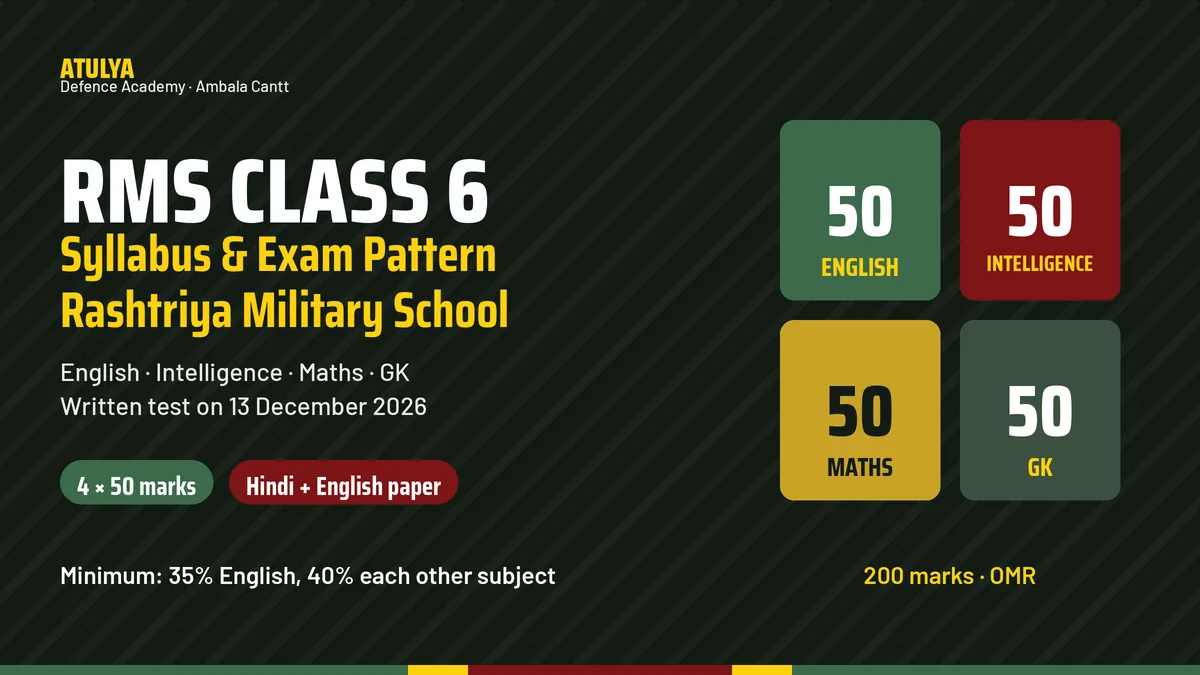
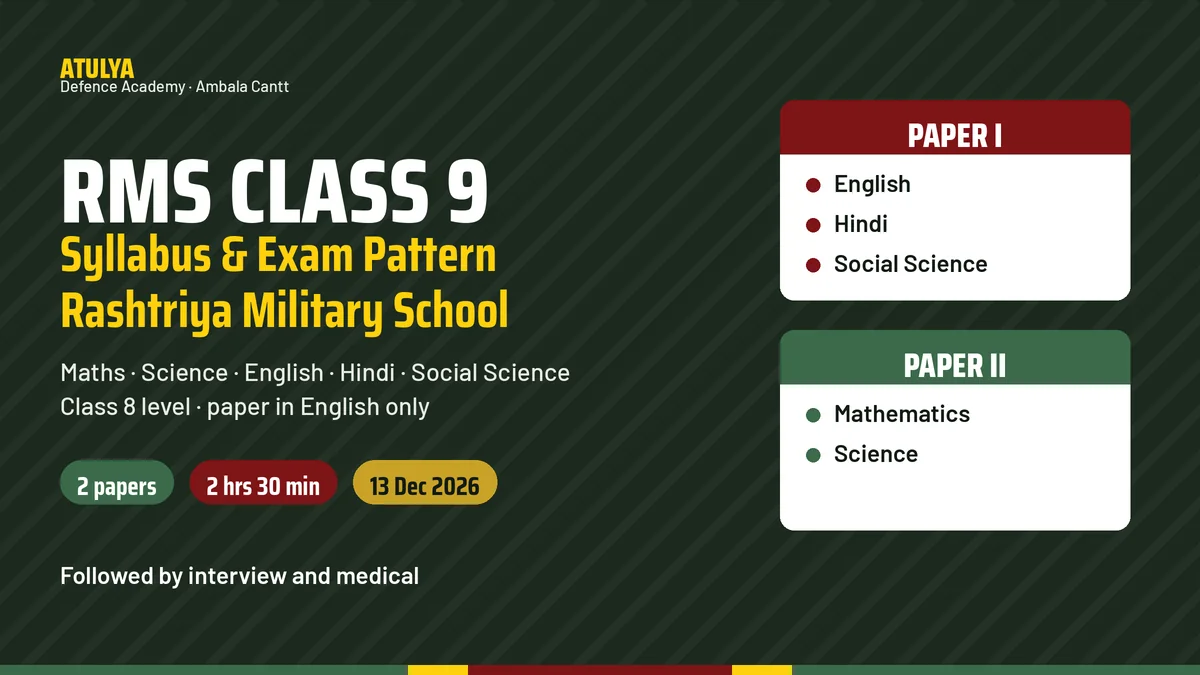
At a glance: two papers covering English, Hindi, Social Science, Mathematics and Science; objective questions on an OMR sheet; 2 hours 30 minutes in total; question paper in English only. Written test on 13 December 2026, followed by an interview and medical for those who qualify.
RMS CET Class 9 exam pattern
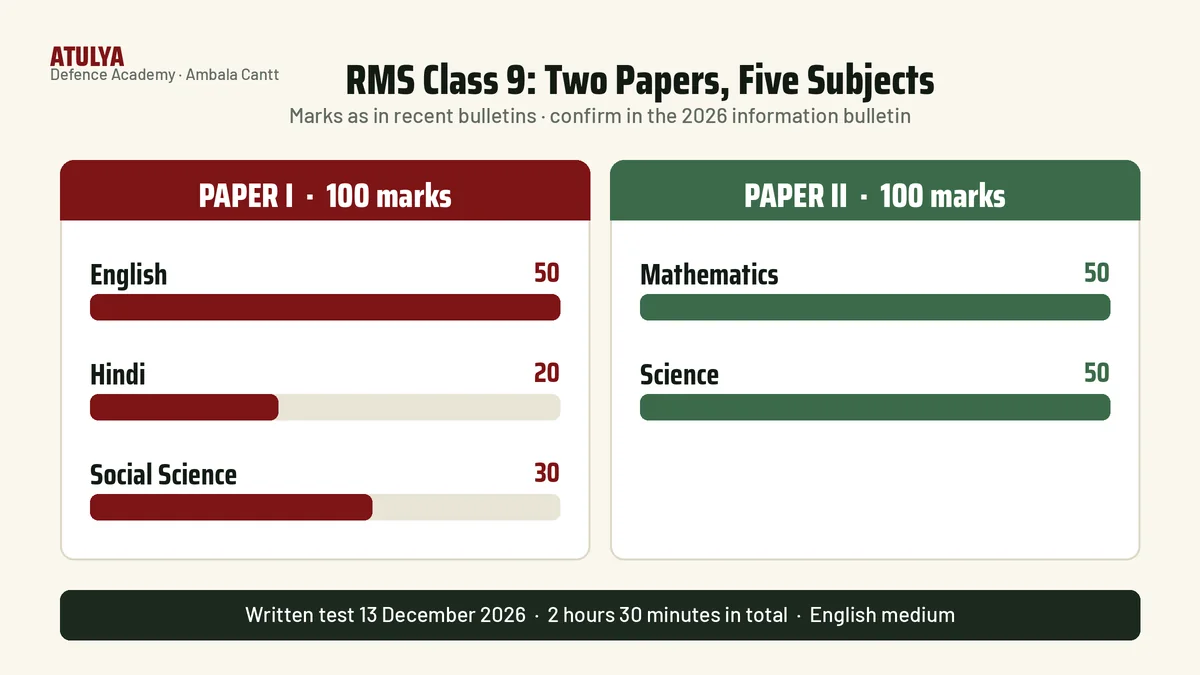
| Paper | Subjects | Marks (as in recent bulletins) |
|---|---|---|
| Paper I | English, Hindi, Social Science | English 50, Hindi 20, Social Science 30 |
| Paper II | Mathematics, Science | Mathematics 50, Science 50 |
| Total | Five subjects, 2 hours 30 minutes | 200 |
The 2026 notice confirms the subjects, two-paper format and duration. Check the subject-wise marks and the minimum qualifying percentage in the current information bulletin on exams.nta.nic.in/rmscet before you plan.
Is English important for RMS Class 9?
It is the single most important factor after maths. English is a full subject worth a quarter of the marks, and it is also the language of every question in maths, science and social science. A child who reads slowly in English loses time across the whole paper, not just in the English section. Children moving from Hindi-medium schools tell us the science questions were the hardest, not because of the science but because of the wording.
What helps: reading one English newspaper article or a chapter of a story book aloud every day, learning the English terms for science and social science concepts from NCERT books, and practising comprehension passages against a timer. Two months of this changes a child's speed noticeably.
Rashtriya Military School Class 9 syllabus: subject-wise topics
RMS class 9 maths
Number and algebra
- Rational numbers
- Exponents and powers
- Squares, square roots, cubes, cube roots
- Algebraic expressions and identities
- Factorisation
- Linear equations in one variable
Arithmetic
- Ratio, proportion, direct and inverse variation
- Percentage, profit, loss and discount
- Simple and compound interest
- Time and work, speed and distance
- Average
Geometry and data
- Lines, angles, parallel lines
- Triangles, quadrilaterals, polygons
- Circles
- Mensuration: area, surface area, volume
- Data handling, pie charts, probability
Compound interest, algebraic identities and mensuration of the cylinder are the three areas where our Class 8 students most often lose marks in mocks. Make a one-page formula sheet for these and revise it twice a week.
Which science topics come in RMS Class 9?
RMS class 9 science follows the Class 8 NCERT science book. The topics that matter:
- Crop production and management
- Microorganisms: friend and foe
- Synthetic fibres and plastics
- Materials: metals and non-metals
- Coal and petroleum
- Combustion and flame
- Conservation of plants and animals
- Cell: structure and functions
- Reproduction in animals
- Reaching the age of adolescence
- Force and pressure
- Friction
- Sound
- Chemical effects of electric current
- Some natural phenomena
- Light
- Stars and the solar system
- Pollution of air and water
Questions are short and factual or need one step of reasoning. Labelled diagrams of the cell, the human eye and the ear are worth revising, as are the uses of common metals and the causes of pollution.
RMS class 9 English
Reading comprehension, vocabulary (synonyms, antonyms, one-word substitution, idioms), grammar (tenses, active and passive voice, direct and indirect speech, modals, prepositions, articles, conjunctions), sentence correction and sentence arrangement. The level is that of a Class 8 CBSE English course, with questions that reward wide reading.
Hindi and Social Science
Hindi
अपठित गद्यांश, पर्यायवाची, विलोम, मुहावरे और लोकोक्तियाँ, संधि, समास, वाक्य शुद्धि, काल, वचन, लिंग। Class 8 Hindi grammar is enough.
Social Science
History: the coming of the East India Company, rural life under colonial rule, 1857, the national movement. Geography: resources, land, water, agriculture, industries. Civics: the Constitution, Parliament, judiciary, social justice.
For social science, a simple timeline of events from 1757 to 1947 on one sheet, and a map of India with the major crops, minerals and industrial regions marked, cover a large share of the questions. Children remember a map they have drawn themselves far better than one they have only looked at.
How to divide preparation time
English gets more time than its marks alone would justify because it lifts performance in every other subject. Hindi gets the least because most children who have studied it to Class 8 need only revision of grammar rules.
Eight weeks to the 13 December paper
One full mock to find gaps. Maths: algebra and identities. Science: first six chapters. Daily English reading.
Maths: interest, percentage, time and work. Science: next six chapters. Social Science history. Hindi grammar twice a week.
Maths: geometry and mensuration. Science: remaining chapters. Two full mocks a week in the real time limit.
Mistakes and formula sheet only. Interview practice in English: introduction, school, interests, why a military school.
Military school ki taiyari me sabse badi galti hai English ko halke me lena. Roz padhne ki aadat, hafte me do mock, aur galtiyon ki copy, bas yahi teen cheezein kaafi hain.
Sample questions at the level of the paper
Written by our faculty to show the standard; they are not taken from any past paper.
1. What is the compound interest on ₹10,000 for 2 years at 10% per annum, compounded yearly? (a) ₹2,000 (b) ₹2,100 (c) ₹2,200 (d) ₹1,100
2. If 3x − 7 = 11, then x equals: (a) 4 (b) 5 (c) 6 (d) 18
3. Which part of the cell controls its activities? (a) Cell wall (b) Nucleus (c) Vacuole (d) Cytoplasm
4. Sound cannot travel through: (a) water (b) steel (c) air (d) vacuum
5. Change to passive voice: "The teacher praised the student." (a) The student was praised by the teacher. (b) The student is praised by the teacher. (c) The teacher was praised by the student. (d) The student praised the teacher.
6. A word meaning "to make something less severe" is: (a) aggravate (b) mitigate (c) inflate (d) ignore
7. The Revolt of 1857 began at: (a) Delhi (b) Kanpur (c) Meerut (d) Lucknow
8. The head of the Indian state is the: (a) Prime Minister (b) President (c) Chief Justice (d) Speaker
Answers: 1 (b), 2 (c), 3 (b), 4 (d), 5 (a), 6 (b), 7 (c), 8 (b).
Balancing school exams with entrance preparation
The written test falls in the middle of the school's second term, often close to half-yearly or pre-board exams in Class 8. Do not drop school work; the Rashtriya Military School Class 9 syllabus overlaps with it heavily, so every chapter learnt properly for school is also entrance preparation. The extra effort should go into two things school does not give: timed objective practice and English reading speed. One hour on school days and three on weekends is enough for most children, provided it is regular.
Mistakes Class 8 students make with this paper
- Leaving Hindi and Social Science for the last week because they "carry fewer marks".
- Reading every maths question twice because of slow English, then running out of time in Paper II.
- Practising only from guide books and never with a printed OMR sheet.
- Assuming the interview is a formality. It counts towards the final merit.
What happens after the RMS written test?
Qualified candidates are called for an interview and a medical examination. The final merit combines the written result and the interview within each category of seats. At this level, the interview often includes questions on current events and on why the child wants to change schools at this stage, so think through a simple, honest answer. Passing Class 8 is a condition of admission, so keep the report card or a bonafide certificate ready.
Eligibility, dates and other questions
What is the age limit for RMS Class 6 and 9?
Class 9: 13 to 16 years on 31 March 2027, born between 1 April 2011 and 31 March 2014 (both included). Class 6: 10 to 13 years, born between 1 April 2014 and 31 March 2017. Wards of personnel killed in action get six months of relaxation in the upper limit.
What is the RMS CET exam date?
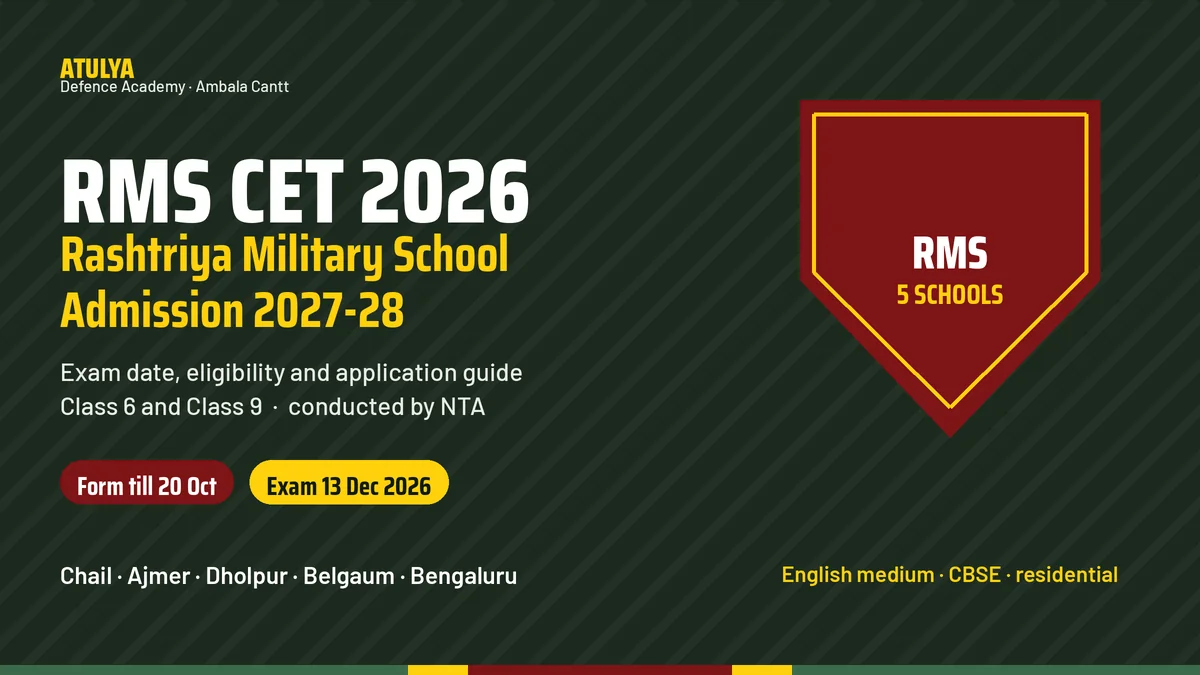
Sunday, 13 December 2026, for both classes. The online form closes on 20 October 2026, with a late window until 25 October on payment of an extra fee. The full process is in our 2026 entrance guide.
How many Rashtriya Military Schools are there?
Five: Chail in Himachal Pradesh, Ajmer and Dholpur in Rajasthan, and Belgaum and Bengaluru in Karnataka. All are residential, English-medium and CBSE-affiliated.
Which RMS is nearest to Punjab and Haryana?
Chail, in the hills of Solan district, roughly four hours by road from Ambala Cantt. Ajmer and Dholpur are the next nearest.
Are girls admitted in RMS?
Girls have been admitted to Class 6 in recent sessions. For Class 9, admission of girls depends on whether the school has girls' seats vacant that year; the bulletin's seat table shows this school by school.
What are RMS fees?
The fee depends on the parent's category. Wards of JCOs and other ranks pay the least, officers' wards pay more, and civilians pay the highest rate. Each school publishes its current fee schedule; ask for the 2027-28 figures, including admission-time charges, before deciding.
Is RMS better than Sainik School?
For Class 9, the better school is often the one with a vacancy. The military schools are run directly under the Army with most seats for service families; Sainik Schools are more numerous, with a large home-state quota. The two tests share most of the Class 8 syllabus and fall on different dates, so applying to both makes sense. Our Sainik School Class 9 syllabus guide covers the second paper.
Aiming for a military school seat?
We run full mocks on this pattern every Sunday at Ambala Cantt, plus English speaking sessions for the interview. Call 98121-97229 or see our coaching programme.
Sources
- National Testing Agency, RMS CET 2026 notice and information bulletin: exams.nta.nic.in/rmscet
- Rashtriya Military Schools, Ministry of Defence: rashtriyamilitaryschools.edu.in
- NCERT Class 8 textbooks: Mathematics, Science, Social Science, English (Honeydew) and Hindi (Vasant)
Pattern as per the NTA notice checked on 17 October 2026.