The Jawahar Navodaya Vidyalaya entrance is unusual among school entrance tests. It does not test GK, it does not test science, and half of its marks come from a section that looks nothing like school work. Parents who prepare their child from regular Class 5 textbooks alone often discover this a month before the test, when the first mock paper comes back with good arithmetic and a weak mental ability score.
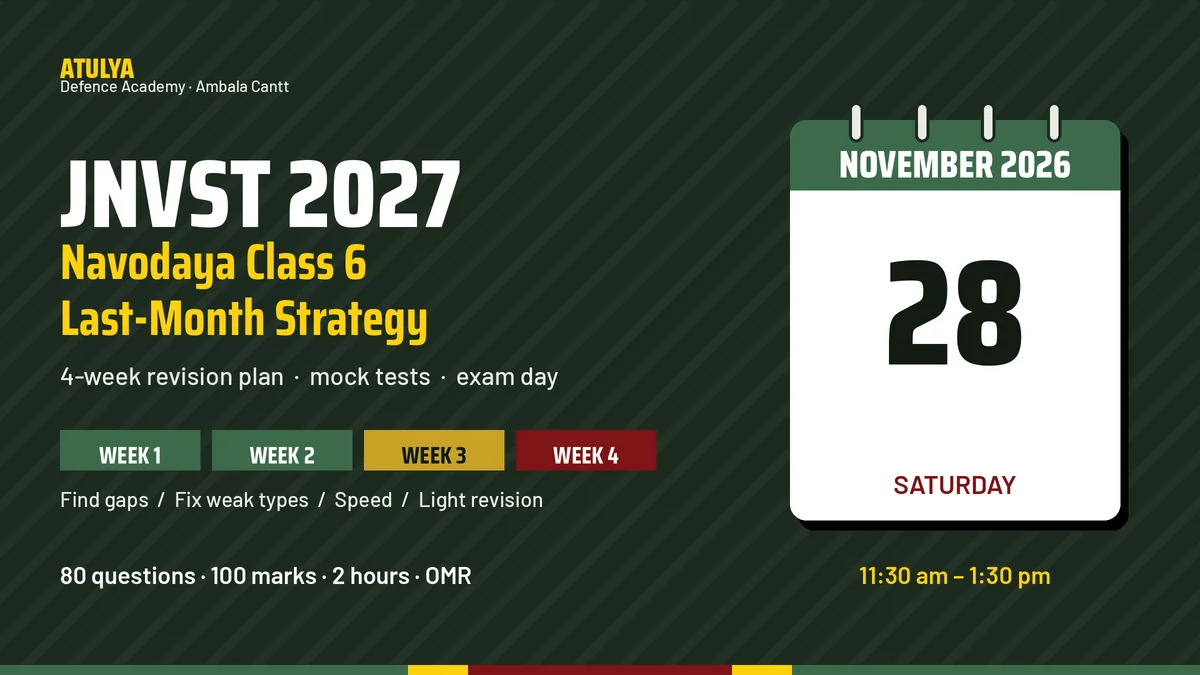
This guide lays out the Navodaya Class 6 syllabus 2027 section by section, including the ten question types of the mental ability test with a short note on each, the exact arithmetic topics, and how the language test works. The test is on Saturday, 28 November 2026. For a last-month routine, see our four-week JNVST plan.
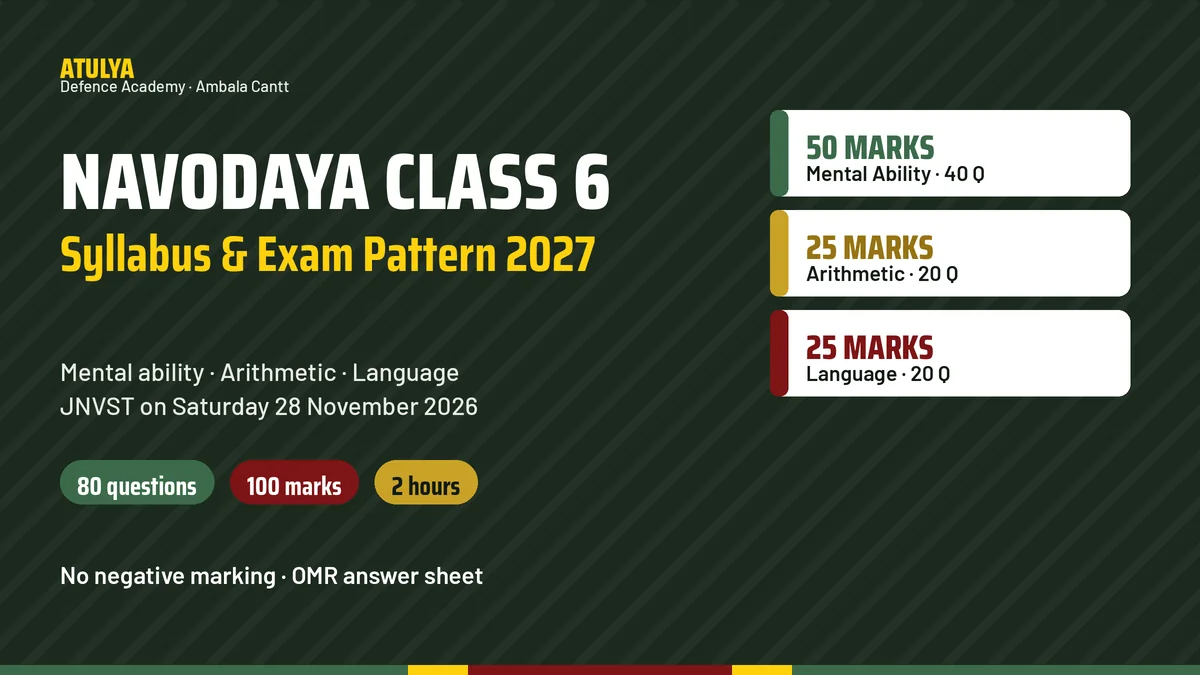
In short: three sections, 80 objective questions, 100 marks, 2 hours, OMR answer sheet. Mental ability carries 50 marks, arithmetic 25 and language 25. There is no negative marking. The paper is available in English, Hindi and the regional languages listed by NVS.
JNVST exam pattern at a glance
| Section | Questions | Marks | Time |
|---|---|---|---|
| Mental Ability Test | 40 | 50 | 60 minutes |
| Arithmetic Test | 20 | 25 | 30 minutes |
| Language Test | 20 | 25 | 30 minutes |
| Total | 80 | 100 | 120 minutes |
The time limits per section are a guide for planning; the paper is handed over as one booklet with one OMR sheet. Children with a disability get extra time as per NVS rules. The test runs from 11:30 am to 1:30 pm.
How many marks are there for mental ability in JNVST?
Fifty out of a hundred. The mental ability section has 40 questions, which makes each question worth 1.25 marks, slightly more than a question in arithmetic or language. This one section decides most results, and it is the one most families under-prepare for.
Navodaya mental ability syllabus: the ten parts
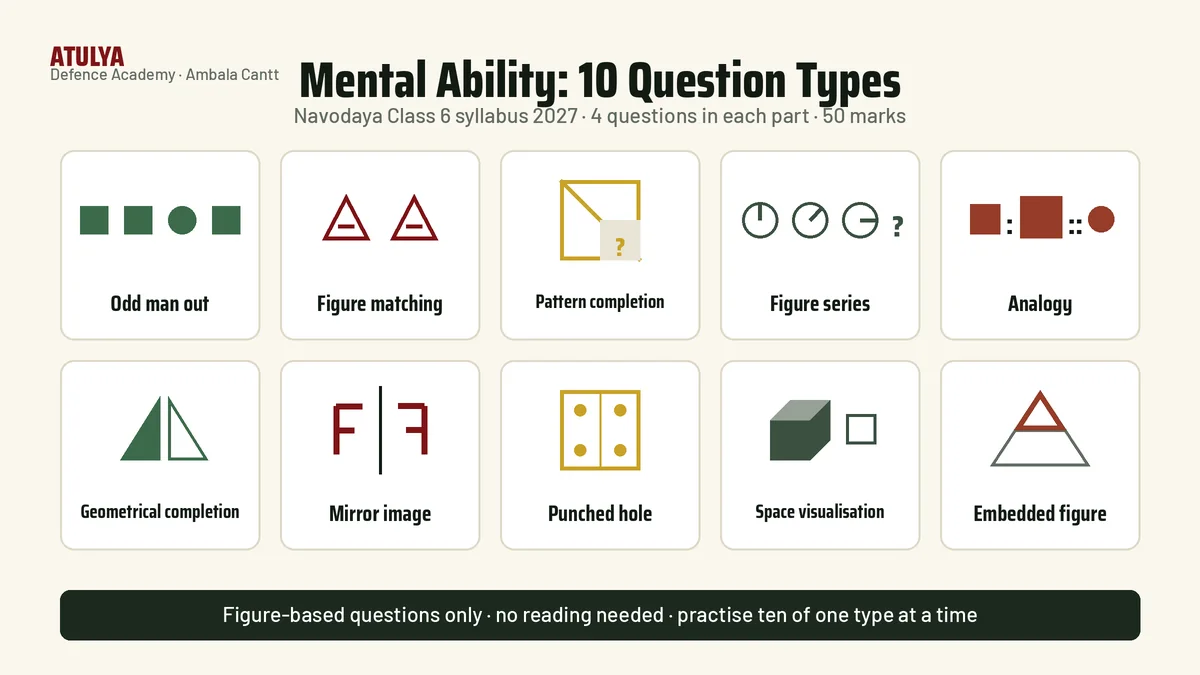
The section is built from ten parts, with four questions in each. All are figure-based; there is no reading involved, which is why children from any language background can do well here.
1. Odd man out
Four or five figures, one differs in shape, number of lines, direction or shading. Train the eye to compare one feature at a time.
2. Figure matching
Find the figure exactly like the given one among options that differ by a small detail.
3. Pattern completion
A square pattern with a missing quarter; pick the piece that completes it.
4. Figure series completion
Figures change step by step (rotation, adding a line); choose the next one.
5. Analogy
A is to B as C is to which figure? Find the rule between the first pair.
6. Geometrical figure completion
Pieces that join to make a given square or triangle.
7. Mirror imaging
The reflection of a figure in a vertical mirror. Left and right swap; top and bottom stay.
8. Punched hole pattern
Paper folded, punched and unfolded; predict the holes.
9. Space visualisation
Which pieces fit together to form a shape.
10. Embedded figure
Find a simple figure hidden inside a more complex one.
In our classes, mirror images, punched hole patterns and embedded figures cause the most errors at first. They are also the types that improve fastest with practice: after three weeks of daily sets, most children move from guessing to getting three out of four right.
Navodaya arithmetic syllabus
The arithmetic test checks basic Class 5 competence. The topics listed by NVS:
- Numbers and numeration
- Four fundamental operations on whole numbers
- Fractional numbers and four operations on them
- Factors and multiples, including their properties
- LCM and HCF
- Decimals and fundamental operations on them
- Conversion of fractions to decimals and decimals to fractions
- Measurement of length, mass, capacity, time and money
- Simplification of numerical expressions
- Percentage and its applications
- Profit and loss
- Simple interest
- Perimeter, area and volume
- Data analysis (bar graphs, tables)
- Geometry basics: types of angles, lines, shapes
Twenty questions in about thirty minutes means ninety seconds each. Children who know their tables to 20 and can handle fractions quickly finish this section with time to check. Those who count on fingers do not. If your child is in the second group, fifteen minutes of mental arithmetic every day will help more than another guide book.
Navodaya language test syllabus
The language test has four reading passages, each followed by five questions. It checks whether a child can read a short text and answer questions about meaning, main idea, a word's sense in context, and simple inference. There is no list of grammar topics to learn. The child writes this section in the language chosen in the application form.
What works in preparation: one passage a day, read silently, then five questions answered within six minutes. Ask the child to put a pencil mark in the passage next to the line that answers each question. This habit cuts careless errors more than anything else we have tried.
Is there negative marking in JNVST?
No. A wrong answer does not reduce the score, so every question should be attempted. In the last five minutes, any remaining bubbles should be filled with the best guess. We see children leave five or six questions blank in mocks out of habit from school exams; correct this early.
Splitting study time across the Navodaya Class 6 syllabus 2027
Give study time in the same ratio as the marks. In practice, a 90-minute evening becomes 45 minutes of figure questions, 25 of arithmetic and 20 of reading. On Sundays, a full 2-hour paper replaces the routine from four weeks before the test.
Sample questions at the level of the test
Written by our faculty to show the standard of the arithmetic and language sections; they are not copied from any past paper. Figure questions cannot be shown well in text, so practise those from printed papers.
1. A pen costs ₹12. How much will 15 such pens cost? (a) ₹150 (b) ₹170 (c) ₹180 (d) ₹200
2. What is 3/4 of 96? (a) 64 (b) 72 (c) 76 (d) 84
3. A rectangle is 9 cm long and 6 cm wide. Its perimeter is: (a) 15 cm (b) 30 cm (c) 54 cm (d) 36 cm
Passage: Ravi's grandmother kept a small notebook in which she wrote the name of every bird that came to the neem tree. By the end of winter, the list had thirty names, and Ravi had learnt to tell a bulbul from a myna by its call alone.
4. What did the grandmother write in the notebook? (a) recipes (b) names of birds (c) Ravi's marks (d) names of trees
5. What did Ravi learn? (a) to draw birds (b) to climb the neem tree (c) to know birds by their calls (d) to write a diary
Answers: 1 (c), 2 (b), 3 (b), 4 (b), 5 (c).
Mistakes we see in the first mock
- Spending three minutes on one figure question. Each is worth the same; skip and return.
- Reading the language passage twice before looking at the questions. Read once, then search for each answer.
- Rushing the arithmetic because the mental ability section took too long, then losing easy marks on simple division.
- Shading two bubbles for one question. The OMR reader marks it wrong.
Material that covers the Navodaya Class 6 syllabus 2027
NCERT Class 5 maths and a Class 5 reader in the chosen language cover the arithmetic and language parts. For mental ability, use one practice book organised by the ten question types and the official sample papers from NVS. Ten years of past papers, solved under the real time limit, are worth more than three new guide books.
Navodaya ki taiyari kaise karein?
Sabse zyada samay mental ability ko dein, kyunki aadhe number wahin se aate hain. Roz das-das sawal do-teen prakar ke, phir arithmetic ke 10 sawal aur ek passage. Hafte me ek poora paper OMR sheet par, aur galtiyon ko ek copy me likhte rahein.
Eligibility and admission rules
How does the Navodaya rural quota work?
At least 75 percent of the seats in each district go to children from rural areas. To be counted as rural, a child must have studied Class 3, 4 and 5 for full sessions in schools located in rural areas. The remaining seats are open to all. One-third of seats are filled by girls, and SC, ST and OBC reservations follow government rules.
Can a student apply to JNV outside the home district?
No. A child can apply only to the JNV of the district where they are studying Class 5 in a government or recognised school. Residence and study in that district are verified at admission.
How many times can a child appear for JNVST?
Only once. A child who has appeared before is not eligible again, so the Class 6 attempt is the only chance for that route. (There is a separate lateral entry test for Class 9.)
Is Navodaya education free?
Schooling, boarding, lodging, uniforms and textbooks are provided by NVS. A small monthly contribution towards the Vidyalaya Vikas Nidhi is collected from some categories of students, while girls, SC and ST students, children from families below the poverty line, and Divyang students are exempt. Ask the JNV for the current amount for your category.
Results and selection
What is the JNVST cut off?
There is no single national cut off. Selection is made district by district, in merit order within rural and urban, gender and category groups. A score that gets a seat in one district may fall short in another with more applicants for the same eighty seats.
When will the Navodaya result come?
Results for the 28 November test are expected around March to April 2027 on navodaya.gov.in and at the district JNV and education offices. Selected children then go through document verification; a waiting list follows if seats remain.
Can a child prepare for Navodaya and Sainik together?
Yes, and many of our Class 5 students do. The arithmetic overlaps almost completely with the maths in the Sainik School paper, and the mental ability practice helps with the intelligence section there. The differences: the Sainik School paper adds GK and gives maths much more weight, and the military school paper adds GK and English. A sensible order is JNVST-focused practice until 28 November, then a shift to the Sainik School paper for January. Our Sainik School Class 6 syllabus lists the extra topics.
Mental ability practice with feedback
Our Ambala Cantt batch runs daily figure-reasoning sets and a full JNVST mock every Sunday until 28 November. Call 98121-97229 or see the JNV preparation programme.
Sources
- Navodaya Vidyalaya Samiti, JNVST 2027 Class 6 prospectus: navodaya.gov.in
- NVS admission portal: cbseitms.rcil.gov.in/nvs
Syllabus and pattern as per the NVS prospectus, checked on 22 October 2026.