Parents often ask for "the syllabus" as if it were a textbook. It is not. The Class 6 entrance has no prescribed book. NTA gives a list of topics in the information bulletin, and the questions are set at roughly the level of Class 5, with a few topics that most schools only touch in Class 6. A child who has done well in Class 4 and 5 school exams already knows about two-thirds of it. The remaining third is where coaching, practice papers and a good plan make the difference.
Below is the Sainik School Class 6 syllabus 2027 broken down section by section, with the topics we see repeated most often in past papers, and a note on how much time each deserves. The exam is on 31 January 2027; dates and the application process are covered separately in our AISSEE 2027 timeline for parents.
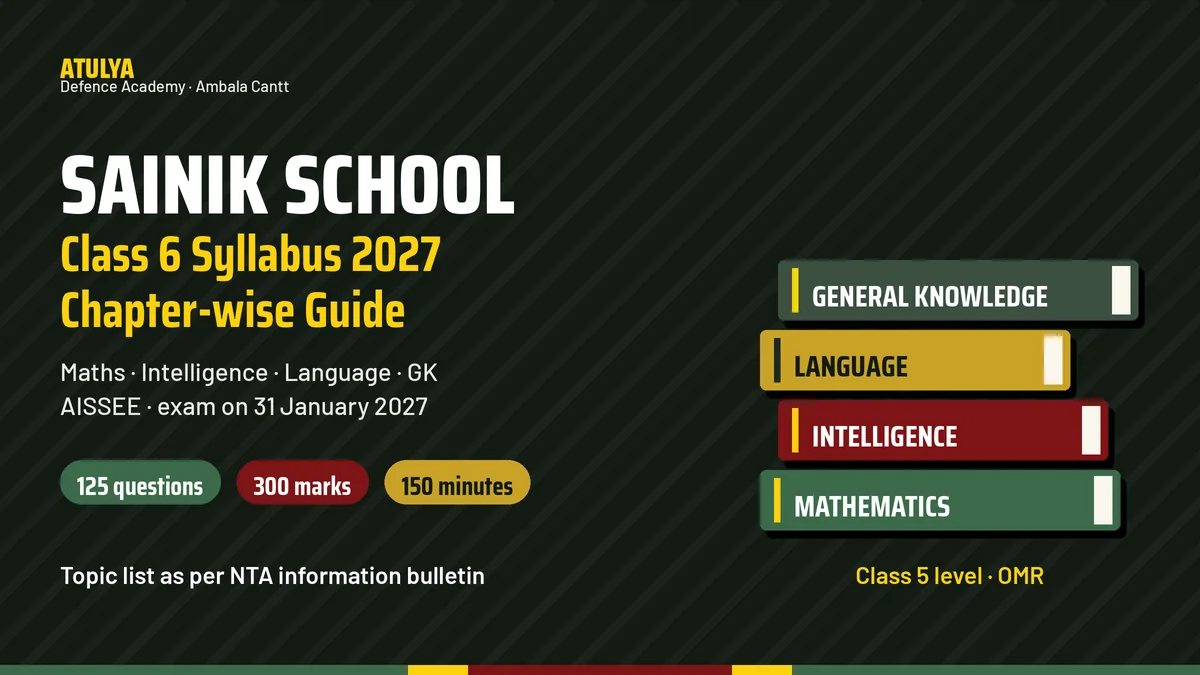
At a glance: the Sainik School Class 6 syllabus 2027 has four sections, 125 questions, 300 marks, 150 minutes. Mathematics alone is 150 marks. Language and GK can be written in English, Hindi or one of the listed regional languages, so a Hindi-medium child is not at a disadvantage.
How many questions are there in AISSEE Class 6?
There are 125 multiple-choice questions, answered on an OMR sheet in a single sitting of two and a half hours. There is no negative marking.
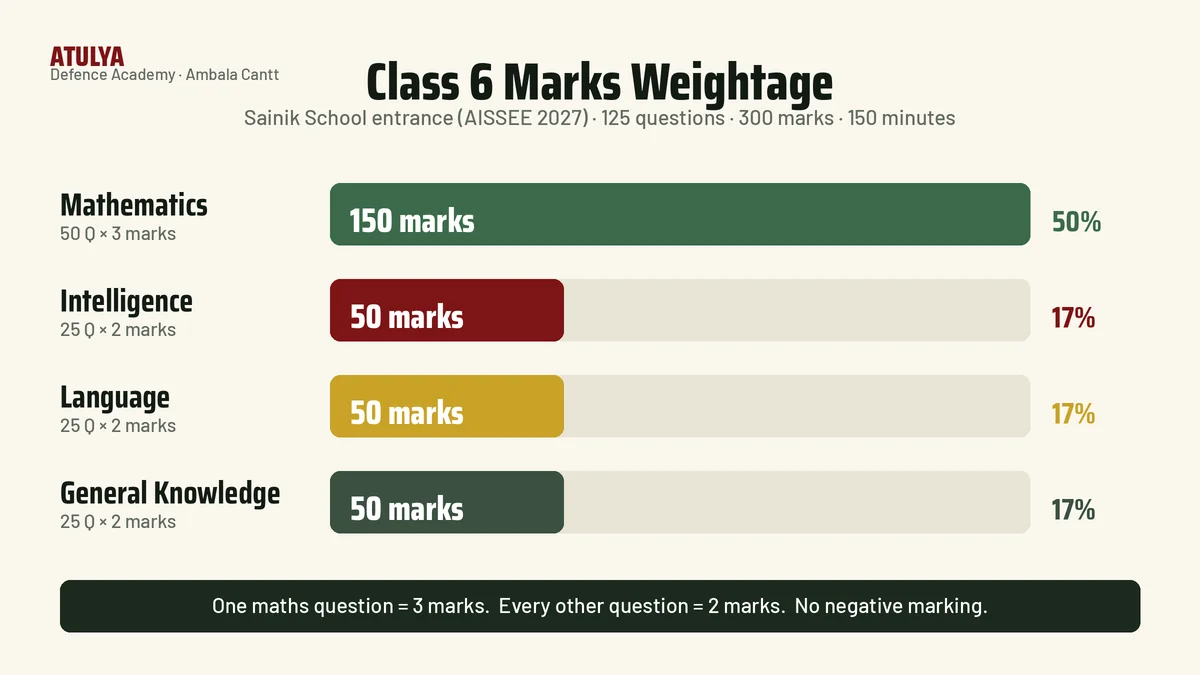
| Section | Questions | Marks per question | Section total |
|---|---|---|---|
| Mathematics | 50 | 3 | 150 |
| Intelligence | 25 | 2 | 50 |
| Language | 25 | 2 | 50 |
| General Knowledge | 25 | 2 | 50 |
This is the AISSEE Class 6 exam pattern 2027 as given in the bulletin. One detail parents miss: a maths question is worth 3 marks while every other question is worth 2. Getting ten more maths questions right adds 30 marks. Getting ten more GK questions right adds 20. Plan the hours accordingly.
Mathematics in the Sainik School Class 6 syllabus 2027
The Sainik School Class 6 maths syllabus in the bulletin lists these topics. We have grouped them so a parent can tick them off:
Numbers
- Natural numbers, whole numbers and operations on them
- Prime and composite numbers, factors and multiples
- LCM and HCF
- Fractions and decimal numbers
- Roman numerals
- Arranging numbers in order, number line
Commercial maths
- Unitary method
- Ratio and proportion
- Percentage
- Profit and loss
- Simple interest
- Conversion of units (length, mass, volume, time, money)
- Temperature
Geometry and mensuration
- Lines and angles, types of angles
- Complementary and supplementary angles
- Plane figures: triangles, quadrilaterals, circle
- Perimeter and area of simple figures
- Volume of cube and cuboid
- Basic data reading from tables and bar graphs
Which maths chapters carry the most weight in AISSEE?
NTA does not publish chapter-wise marks, so any exact breakdown you see online is someone's estimate. What we can say from sorting several years of past papers in our classroom is this: word problems on fractions, unitary method, percentage, profit and loss, and simple interest together make up the largest block. Next come LCM and HCF, area and perimeter, and angles. Roman numerals, temperature and unit conversion appear every year but usually as one or two quick questions each.
So the order of practice we follow is: fractions and decimals first (they feed into everything else), then the commercial maths group, then geometry and mensuration, and the short topics last. A Class 5 child who can solve a two-step word problem on profit or interest in under ninety seconds is in good shape for this section.
Common maths traps
- Mixing up area and perimeter units (cm and cm²) in the options.
- Converting minutes to hours as decimals: 45 minutes is 0.75 hour, not 0.45.
- Reading "loss per cent" on the selling price instead of the cost price.
- Rushing the last ten maths questions because time ran out on GK.
Intelligence: what the 25 questions test
This section checks reasoning, not school knowledge. The question types that appear most often are:
- Analogy (word, number and figure)
- Classification or odd one out
- Number and letter series
- Coding and decoding
- Pattern completion and figure series
- Mirror and water images
- Paper folding and cutting
- Embedded and hidden figures
- Direction sense
- Blood relations (simple)
- Counting figures (triangles, squares)
- Venn diagrams
Children either find these easy at once or find them baffling. The baffled group improves fastest with short daily sets: fifteen questions in ten minutes, every day for six weeks, does more than a long weekend session.
Language: English or Hindi paper
The language section is chosen in the form. Many families search for the Sainik School syllabus in Hindi; the topic list is the same whichever language your child picks. The English version covers:
- Reading comprehension (one or two short passages)
- Synonyms, antonyms, one-word substitution
- Nouns, pronouns, verbs, adjectives, adverbs
- Prepositions, conjunctions, articles
- Tenses and subject-verb agreement
- Singular and plural, gender, collective nouns
- Sentence correction and rearrangement
- Common idioms and spelling
The Hindi paper tests the equivalent: अपठित गद्यांश, पर्यायवाची, विलोम शब्द, संज्ञा, सर्वनाम, विशेषण, काल, लिंग, वचन, मुहावरे and वर्तनी. A child should write the section in the language they read most comfortably, not the one the parents think sounds better.
General Knowledge: science and social studies
GK is the section families worry about most and the one that moves the total least. It has two parts.
Science side
- Plants and animals, their parts and uses
- Human body, food and nutrition, diseases
- Air, water and weather
- Simple machines, magnets, light and sound basics
- Solar system and the Earth
Social studies side
- Indian history: key rulers, freedom struggle
- Geography of India: states, rivers, mountains
- Indian culture, festivals, dances
- Government basics, national symbols
- Sports, awards, books and authors, defence forces
NCERT EVS books of Class 3 to 5 cover most of the science side. For current affairs, a children's news page read aloud three times a week is enough; there is no need to buy a thick yearbook for a ten-year-old.
Where to get the AISSEE Class 6 syllabus PDF
The only authentic AISSEE Class 6 syllabus PDF is the one inside the information bulletin on exams.nta.ac.in/AISSEE. Download the bulletin, find the "Syllabus" appendix and print those two pages. Lists circulating on messaging apps are often from older years and sometimes add topics that are not tested.
A 12-week plan to cover the Sainik School Class 6 syllabus 2027
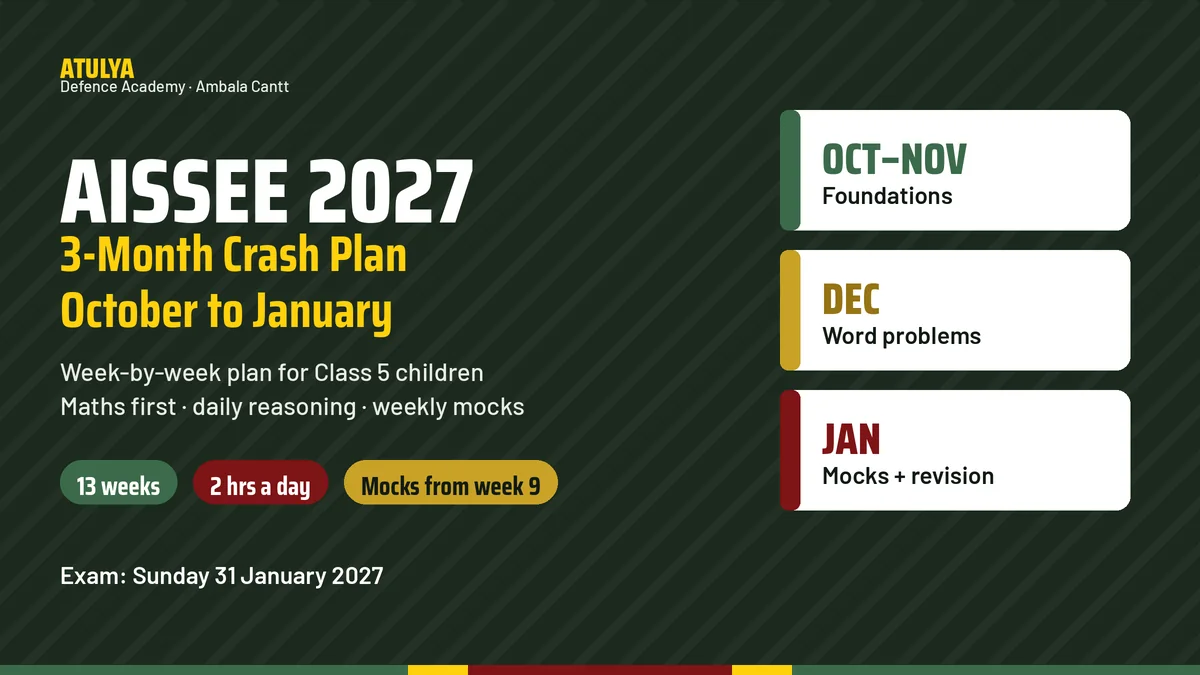
6 days a week. Concept in the first half of the plan, mixed word problems in the second half.
Daily short timed sets. One new question type every two days.
One passage and one grammar topic a day.
EVS revision plus news three times a week.
From week 8, add one full mock every week in 150 minutes on a printed OMR sheet, and work through previous year papers. The day after each mock goes to correcting mistakes, not to new chapters.
What happens after clearing the AISSEE written exam?
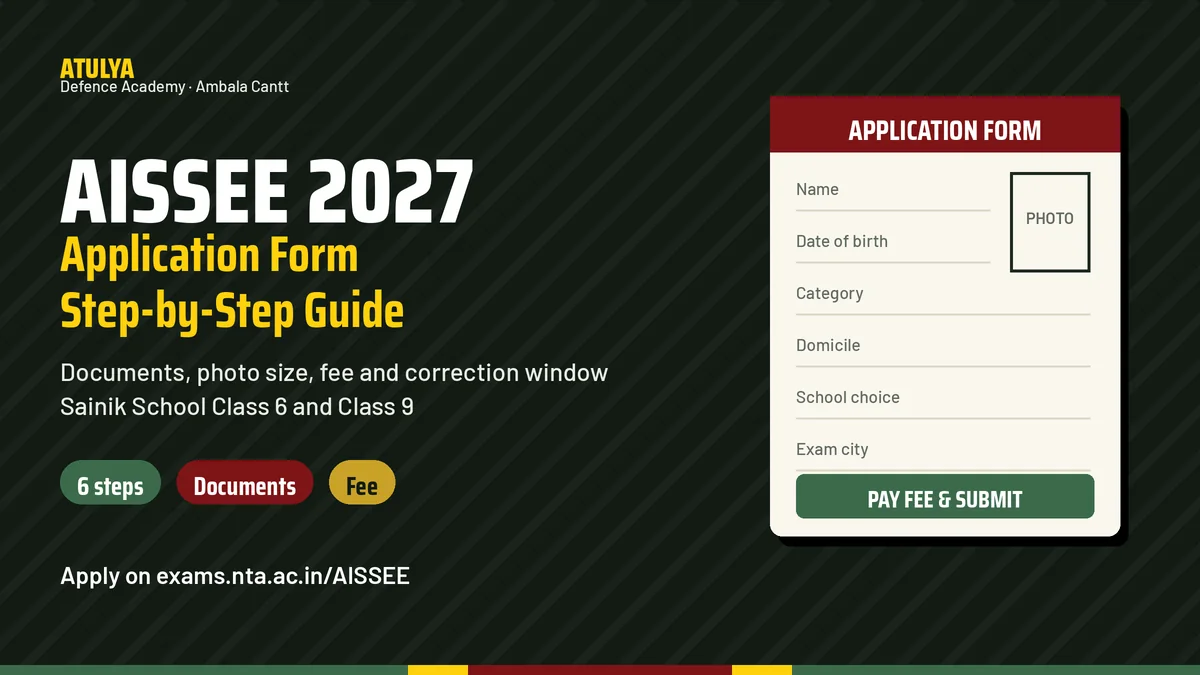
The written score only puts a child on the list. Next comes e-counselling, where seats are allotted by rank and by the choices filled; then a medical examination at the allotted school; and then a check of original documents. A child who scores well but fails the medical or brings a birth certificate that does not match the form can still lose the seat, so keep papers ready early.
What is the home-state quota in Sainik Schools?
Two-thirds (67 percent) of seats in each of the older Sainik Schools are kept for children from the state where the school is located. The rest are open to other states. For a child domiciled in Haryana, that makes Kunjpura and Rewari the schools where the home-state seats sit. Within these shares, there is reservation for SC, ST, OBC (non-creamy layer) and a defence wards quota for children of serving and retired personnel.
How is the Sainik School merit list prepared?
Only children who score at least 25 percent in every section and 40 percent overall qualify (in the older Sainik Schools, SC and ST candidates are exempt from this minimum). Qualified children are ranked within each school, quota and category. There is no single all-India cut off marks figure; it varies by school and by year.
Which is better: old or new Sainik School?
The 33 older Sainik Schools are run by the Sainik Schools Society and have a long record of sending cadets to NDA. New Sainik Schools are existing schools that have partnered with the Society; their facilities and fees vary much more. Most reserve only part of their seats for AISSEE candidates from outside. If your child gets a choice, visit or speak to parents at both before deciding. A new school close to home with good teaching can serve a child better than a famous old school where they are unhappy.
How many Sainik Schools are there in India?
There are 33 Sainik Schools under the Sainik Schools Society, and a growing number of New Sainik Schools added since 2022. Check the seat table in the current bulletin for the exact list for 2027-28.
Are girls eligible for Sainik School admission?
Yes. Girls have been admitted to Class 6 in all Sainik Schools since the 2021-22 session, and they write the same paper with the same syllabus.
Is coaching necessary for Sainik School?
The syllabus itself is within reach of a good Class 5 student. What is hard to manage at home is the speed: 125 questions in 150 minutes, with maths taking most of that time. Whether a child joins coaching or not, they need timed papers, OMR practice and someone who checks why the same mistakes repeat. At Atulya, Class 5 children prepare for AISSEE alongside regular CBSE studies on a residential campus; see the Sainik School entrance programme for how the day is organised.
Sainik School ki taiyari kab se shuru karein?
Class 4 ke aakhir se maths ki buniyad mazboot karna shuru karein, aur Class 5 ki shuruaat se poore syllabus ki taiyari. Agar abhi shuru kar rahe hain, to upar diya 12 hafte ka plan follow karein aur maths ko sabse zyada samay dein.
Questions parents ask us
How many questions are there in AISSEE Class 6?
125 questions for 300 marks in 150 minutes: 50 in Mathematics and 25 each in Intelligence, Language and General Knowledge.
Which maths chapters carry the most weight in AISSEE?
NTA does not publish chapter weights. In past papers, word problems on fractions, unitary method, percentage, profit and loss and simple interest form the largest group, followed by LCM/HCF, area and perimeter, and angles.
How is the Sainik School merit list prepared?
Children with at least 25 percent in each section and 40 percent overall are ranked school-wise within home-state, other-state, category and defence quotas.
Is coaching necessary for Sainik School?
Not compulsory, but timed practice, OMR sheets and regular mock tests are needed, and coaching makes that routine easier.
Sainik School ki taiyari kab se shuru karein?
Class 4 ke aakhir se maths ki buniyad, aur Class 5 me poore syllabus ki taiyari.
How many Sainik Schools are there in India?
33 Sainik Schools under the Sainik Schools Society, plus New Sainik Schools listed in each year's bulletin.
Are girls eligible for Sainik School admission?
Yes, girls can apply for Class 6 in all Sainik Schools and write the same paper.
What happens after clearing the AISSEE written exam?
E-counselling for seat allotment, a medical examination at the allotted school, and verification of original documents.
Which is better: old or new Sainik School?
Older Sainik Schools have a long NDA record; New Sainik Schools vary more in facilities and fees. Compare teaching, hostel care and distance from home before choosing.
What is the home-state quota in Sainik Schools?
67 percent of seats in the older Sainik Schools are for children domiciled in the state where the school is located.
Check where your child stands
We run a full Class 6 mock on OMR sheets every Sunday at our Ambala Cantt campus, with a section-wise report the same day. Call 98121-97229 or see the mock test schedule.
Sources
- National Testing Agency, AISSEE 2027 information bulletin, syllabus appendix: exams.nta.ac.in/AISSEE
- Sainik Schools Society, Ministry of Defence: sainikschool.ncog.gov.in
- NCERT textbooks, Mathematics and EVS, Classes 3 to 5
Topic list as per the bulletin available on 17 October 2026.