The Class 9 entry to a Sainik School is a smaller door than Class 6. Most schools take only enough students to fill seats left vacant by cadets who have moved on, so the number of seats is a fraction of the Class 6 intake while the number of applicants stays large. That makes the paper more competitive than its syllabus suggests. The topics are mostly what a sincere Class 8 student studies anyway. The difference between selection and a near miss is usually speed in maths and how well a child handles the four other subjects together.
This guide lays out the Sainik School Class 9 syllabus 2027 subject by subject, the marking scheme, and a preparation order that fits around Class 8 school exams.
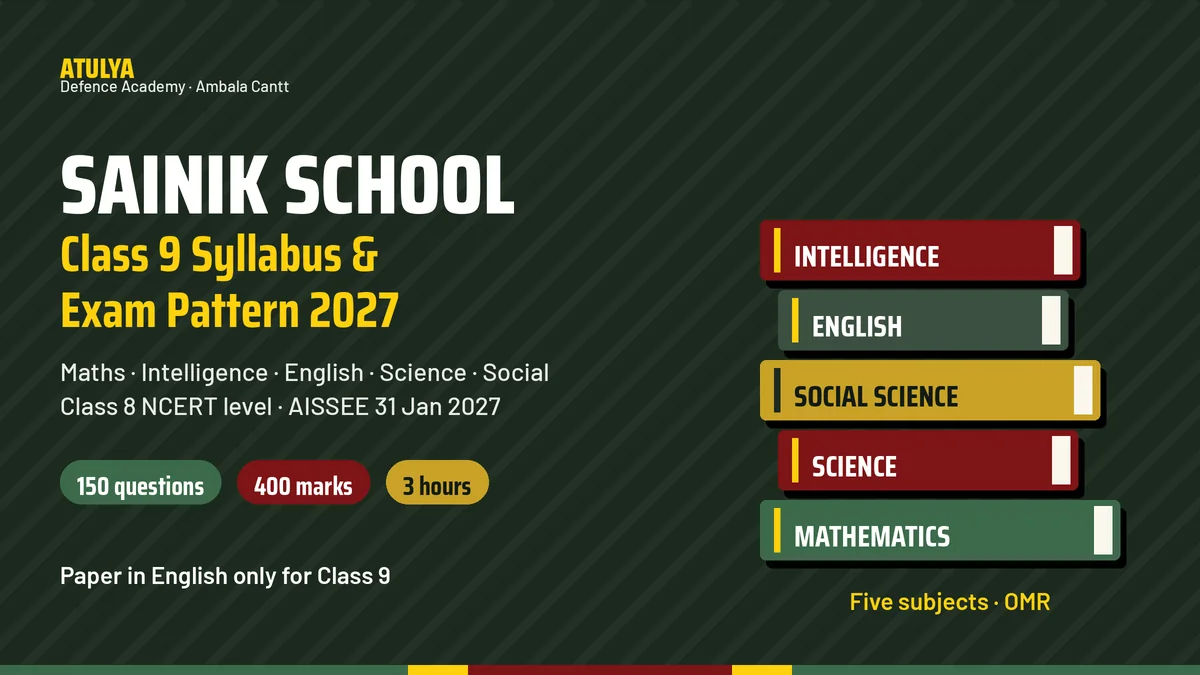
In short: five subjects, 150 questions, 400 marks, 3 hours, OMR sheet, no negative marking. Maths is 200 of the 400 marks. The paper is in English only for Class 9.
How many subjects are in AISSEE Class 9?
Five. The AISSEE Class 9 exam pattern given in the bulletin, which is the base of the Sainik School Class 9 syllabus 2027, is:
| Subject | Questions | Marks each | Total |
|---|---|---|---|
| Mathematics | 50 | 4 | 200 |
| Intelligence | 25 | 2 | 50 |
| English | 25 | 2 | 50 |
| General Science | 25 | 2 | 50 |
| Social Science | 25 | 2 | 50 |
| Total (180 minutes) | 150 | – | 400 |
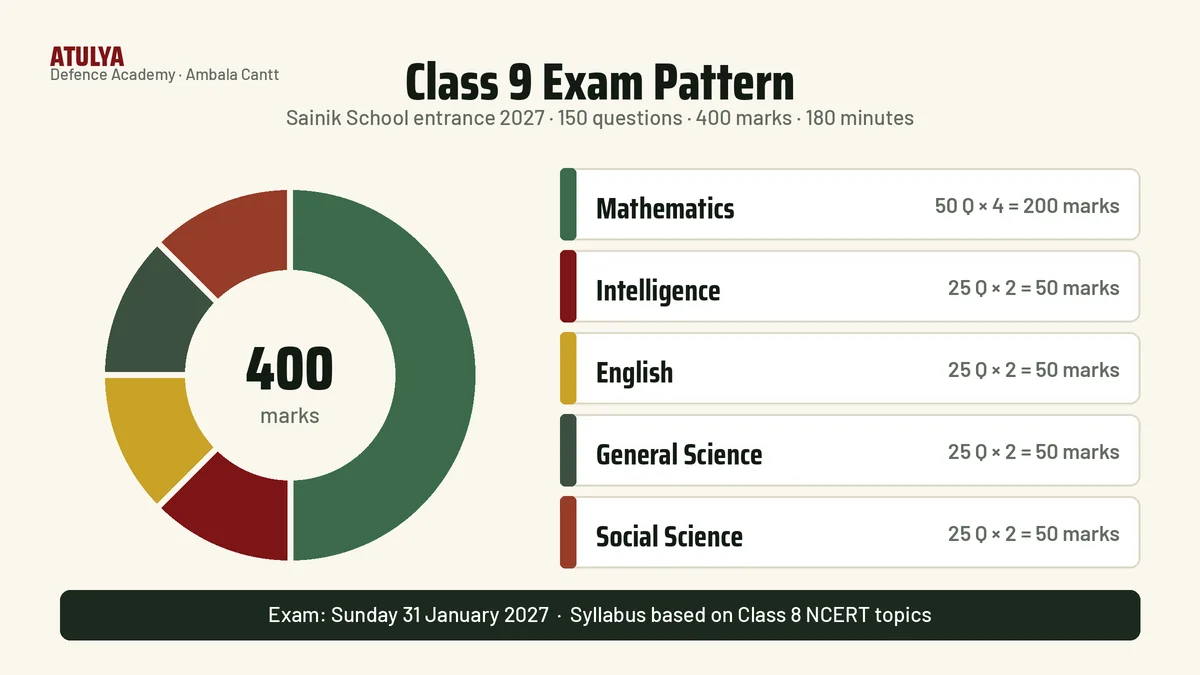
Each maths question carries 4 marks; every other question carries 2. Fifty maths questions in a three-hour paper sounds generous until you see that the other 100 questions also need time. We advise children to aim for about 95 minutes on maths and 85 minutes on everything else, including a final check of the OMR sheet.
Is the Class 9 AISSEE paper based on Class 8 NCERT?
Largely, yes. The topic list in the bulletin follows Class 8 content, and NCERT Class 8 books in maths, science and social science cover nearly all of it. The questions, though, are not lifted from NCERT exercises. They are short application problems that test whether a child understands a concept well enough to use it quickly. A child who has only memorised textbook answers will find the paper harder than one who has practised mixed problems.
Sainik School Class 9 maths syllabus
Number and algebra
- Rational numbers
- Exponents and powers
- Squares and square roots, cubes and cube roots
- Algebraic expressions and identities
- Linear equations in one variable
- Factorisation
Arithmetic
- Ratio and proportion, direct and inverse variation
- Percentage
- Profit, loss and discount
- Simple and compound interest
- Average
- Speed, time and distance; time and work
Geometry, mensuration, data
- Lines, angles and parallel lines
- Triangles and their properties, Pythagoras theorem
- Quadrilaterals and polygons
- Circles
- Area and perimeter; surface area and volume of cube, cuboid and cylinder
- Pie charts, bar graphs and basic probability
Compound interest, algebraic identities, mensuration and time-speed-distance are where we see Class 8 students lose the most marks in our mocks. They are also the topics where a few formulas, practised until automatic, save a lot of time.
AISSEE Class 9 science syllabus
General Science follows the Class 8 science book closely. The chapters to cover are:
- Crop production and management
- Microorganisms
- Synthetic fibres and plastics
- Metals and non-metals
- Coal and petroleum
- Combustion and flame
- Conservation of plants and animals
- Cell structure and functions
- Reproduction in animals
- Reaching the age of adolescence
- Force and pressure
- Friction
- Sound
- Chemical effects of electric current
- Natural phenomena (lightning, earthquakes)
- Light and the human eye
- Stars and the solar system
- Pollution of air and water
Most science questions are one-line facts or simple reasoning. Diagrams matter: the eye, the cell, and the parts of a flower all turn up as "identify the labelled part" questions.
Social Science and English
Social Science
History: how the East India Company gained power, rural life under British rule, the revolt of 1857, the national movement.
Geography: resources, land, soil, water, agriculture, industries, human resources.
Civics: the Constitution, Parliament, the judiciary, marginalisation and public facilities.
English
Reading comprehension, vocabulary (synonyms, antonyms, one-word substitution), grammar (tenses, voice, narration, prepositions, articles, modals), sentence correction and arrangement, idioms and phrases.
Because the Class 9 paper is in English only, children from Hindi-medium schools should start reading English passages daily from now. Ten minutes of reading aloud and five vocabulary words a day builds the comfort needed to read questions fast in all five subjects, not just the English section.
Sainik School Class 9 entrance exam: how to divide preparation time
This split keeps maths at the centre without starving the other four subjects, each of which still carries 50 marks. Intelligence gets more time than its marks suggest because it improves quickly with practice and gives easy marks once the question types are familiar.
Use previous year papers from the third month onward. One full mock a week in 180 minutes on an OMR sheet, followed by a day of correcting mistakes, is the rhythm that works for most of our Class 8 students. Residential coaching helps here mainly because the routine runs without the parent having to enforce it every evening.
Covering the Sainik School Class 9 syllabus 2027 before 31 January
From mid-October there are about fifteen weeks left. That is enough for a Class 8 student who studies steadily, provided school exams are planned in. Here is how we pace it:
Finish the maths topics not yet taught in school: compound interest, mensuration of the cylinder, time and work. Science and social science: one chapter every two days, with a ten-question quiz on each.
Mixed maths practice of 25 questions a day against the clock. Two full mocks this month. Revise the science diagrams and the history timeline.
One full mock every week, then only revision of the mistake notebook in the last ten days. Admit card printed, route to the centre checked.
Mistakes Class 8 students make with this paper
- Treating it like a school exam and preparing only maths and science, leaving social science for the last week.
- Spending more than two minutes on one maths question. At 4 marks each, a skipped hard question costs less than five rushed easy ones.
- Not reading English passages until December, then struggling with question speed in every subject.
- Ignoring the medical. Eyesight below the standard or untreated dental problems can delay or stop admission.
- Assuming the 2026 seat count will repeat. Vacancies for the Sainik School Class 9 syllabus 2027 cycle depend on how many cadets each school loses this year.
Exam dates for the 2027 cycle
What is the AISSEE 2027 exam date?
Sunday, 31 January 2027, the same day as the Class 6 paper. It runs for three hours.
What is the last date to apply for AISSEE 2027?
The closing date is in the information bulletin on exams.nta.ac.in/AISSEE. The form opened with the notice on 13 October 2026 and usually stays open for about three weeks. Our 2027 entrance timeline lists every stage from application to counselling.
Seats, quotas and selection
What is the home-state quota in Sainik Schools?
In the older Sainik Schools, 67 percent of seats go to children domiciled in the school's state and 33 percent to other states. Within that, seats are reserved for SC (15 percent), ST (7.5 percent), OBC non-creamy layer (27 percent), and 25 percent for the defence wards quota. For this class the total vacancy is small, so even one quota slot matters.
What happens after clearing the AISSEE written exam?
Qualified candidates in the entrance (25 percent in each subject, 40 percent overall) are ranked, and seats are offered through e-counselling. A medical examination follows at the school, then document verification. Candidates should keep their Class 8 report card or a bonafide certificate from their current school ready, because passing Class 8 is a condition of admission.
How many marks are safe for AISSEE Class 6?
Parents of younger siblings often ask this. There is no official safe score for either class; cut off marks shift with seats and applicants each year and differ from school to school. For Class 6, children in our batches who consistently score above 75 percent in full-length mocks tend to be in a comfortable position. For the higher class, where seats are fewer, we push for 80 percent or more in mocks.
Which is better: old or new Sainik School?
Older Sainik Schools are fully run under the Sainik Schools Society and have decades of NDA results. New Sainik Schools are partner schools whose quality and fees vary. At this level, availability often decides it: a new Sainik School may have more open seats. Visit, ask about hostel care and teaching, and talk to current parents.
How many Sainik Schools are there in India?
33 Sainik Schools under the Society, plus New Sainik Schools approved since 2022. Not all of them have vacancies at this level every year, so check the seat matrix in the 2027 bulletin.
Are girls eligible for Sainik School admission?
Girls are admitted to Class 6 in all Sainik Schools. For Class 9, girls may apply where the school has vacancies for girls; the seat table in the bulletin shows which schools do.
Questions parents ask us
Is the Class 9 AISSEE paper based on Class 8 NCERT?
Mostly. The topics follow Class 8 NCERT maths, science and social science, but questions test quick application rather than textbook answers.
How many subjects are in AISSEE Class 9?
Five: Mathematics (200 marks), Intelligence, English, General Science and Social Science (50 marks each), for 400 marks in 3 hours.
How many Sainik Schools are there in India?
33 under the Sainik Schools Society, plus New Sainik Schools listed in each year's bulletin.
Are girls eligible for Sainik School admission?
Yes for Class 6 in all schools; for Class 9 where vacancies for girls exist.
What happens after clearing the AISSEE written exam?
E-counselling for seat allotment, a medical test at the school, and verification of documents including proof of passing Class 8.
Which is better: old or new Sainik School?
Older schools have a long NDA record; new ones vary. Compare teaching, hostel care, fees and seat availability.
What is the home-state quota in Sainik Schools?
67 percent of seats in the older Sainik Schools are for children domiciled in that state.
How many marks are safe for AISSEE Class 6?
There is no official safe score. Scoring above 75 percent consistently in full mocks usually puts a child in a strong position.
What is the AISSEE 2027 exam date?
Sunday, 31 January 2027.
What is the last date to apply for AISSEE 2027?
It is printed in the NTA information bulletin on exams.nta.ac.in/AISSEE; the window usually runs about three weeks from 13 October 2026.
Class 8 student aiming for a Sainik School?
Our Ambala Cantt campus runs ninth-standard entrance preparation alongside CBSE Class 8 studies, with a full OMR mock every week. Call 98121-97229 or read about the Sainik School entrance programme.
Sources
- National Testing Agency, 2027 information bulletin, syllabus appendix: exams.nta.ac.in/AISSEE
- NCERT Class 8 textbooks: Mathematics, Science, Social and Political Life, Resources and Development, Our Pasts III
- Sainik Schools Society, Ministry of Defence: sainikschool.ncog.gov.in
Syllabus as per the bulletin available on 17 October 2026.